01High
Insufficient bakehouse extraction
Ovens in production need suitable extraction: capacity and routing to verify.
AvantBail report — food artisan trades
A food-artisan shop does not read like a restaurant: the unit is retail, production happens in a bakehouse or lab, and the economics rest on foot traffic — often from early morning. AvantBail gathers these signals into a pre-diagnostic: what is confirmed, what is likely, and the points to verify before you commit.
Permitted use, production and clientele follow a different logic — that of artisan food retail, not sit-down dining.
The unit must allow an artisan food-retail activity — a zoning read distinct from a restaurant's.
Dedicated production (ovens, sheeter, cold room) brings its own extraction, energy and layout constraints.
Revenue happens at the counter: pedestrian flow, shopfront visibility and the morning peak are decisive.
The angles that matter most for a bakery, a pastry shop or an artisan workshop with counter sales.
PLU and permitted-use read to place the feasibility of an artisan food-retail activity at this address.
Extraction and ventilation constraints of oven-based production, to validate with the co-ownership and a professional.
Electrical or gas needs of an intensive bakehouse, weighed against the capacity available at the unit.
Passing flow, shopfront visibility and the morning peak around the address, as the engine of counter revenue.
Public-reception obligations for a shop serving customers, to examine on the entrance and the sales floor.
Declarations and hygiene rules to anticipate for artisan food production.
The density of food shops and the surrounding retail fabric as a siting context.
Every finding carries its status and the source used.
Every line carries a status and a note. Sample extract, no real data.
Confirmés
Probables
À vérifier
Examples of points that can change a decision on a food-artisan shop.
Ovens in production need suitable extraction: capacity and routing to verify.
An intensive bakehouse may exceed the electrical or gas capacity available at the unit.
The unit may not allow an artisan food-retail activity, to verify.
Insufficient passing flow, especially in the morning, weakens counter economics.
The entrance or sales floor may require accessibility works.
Items to gather and points to document before signing.
Free resources
A food-artisan shop has its own constraints: permitted use, bakehouse, energy and foot traffic. Our resources gather the points to examine before you launch. Informational content, to complete with the relevant professional.
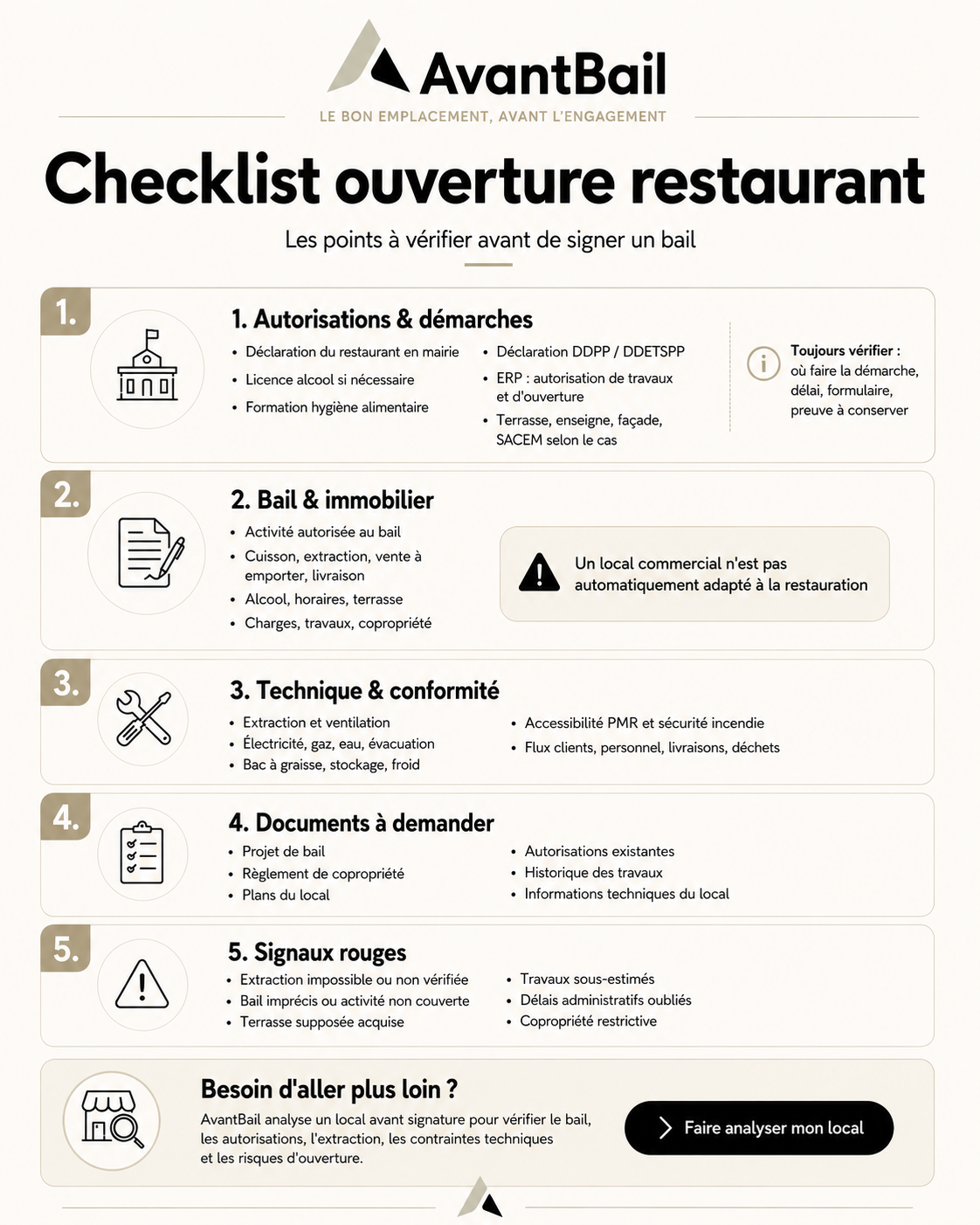
Restaurant traditionnel
Avant d’ouvrir un restaurant en France, vérifiez les autorisations, le bail, l’ERP, l’hygiène, la licence alcool, l’extraction, la terrasse, la façade, les travaux et les risques du local.
Open the checklist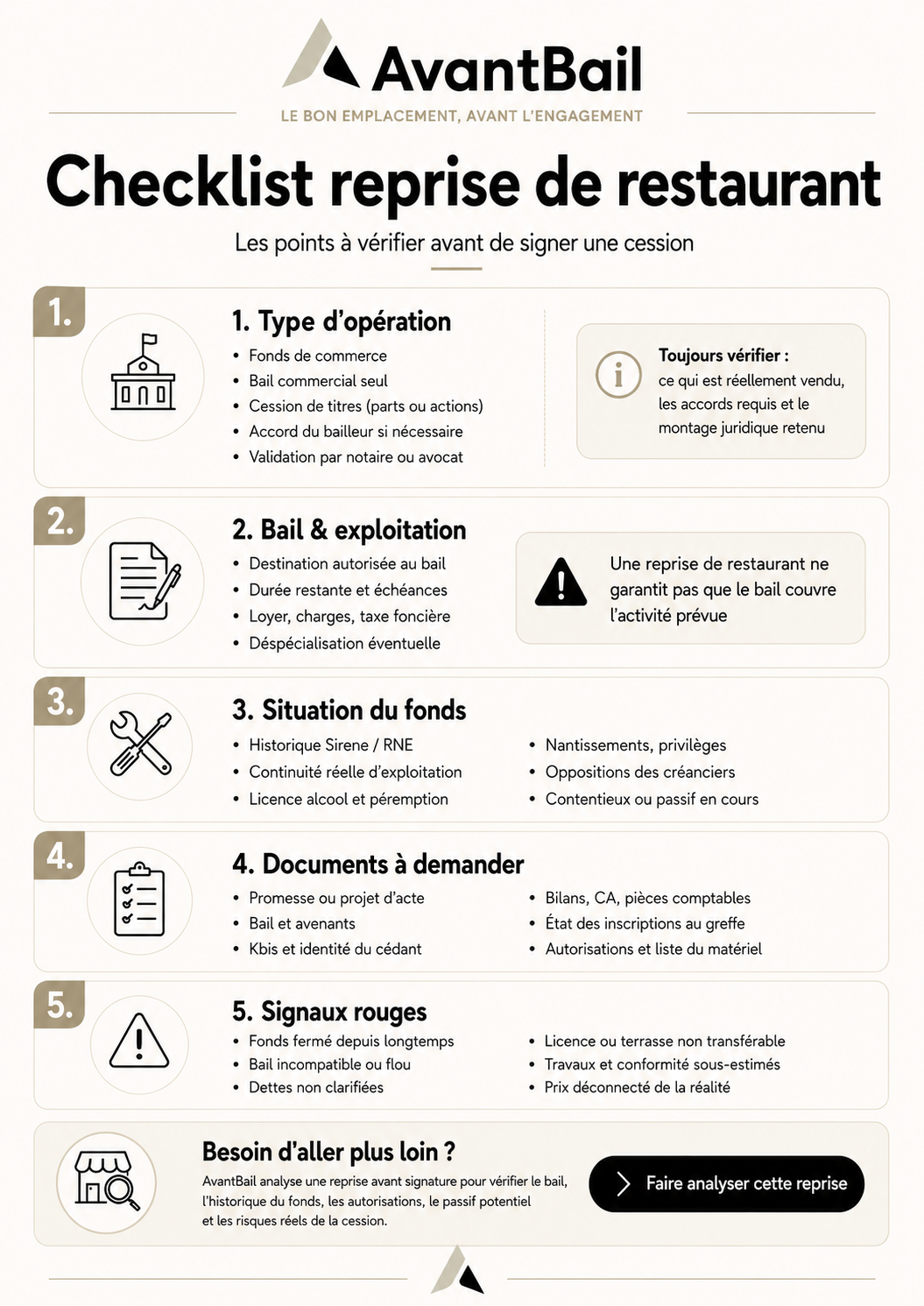
Reprise de restaurant
Avant de reprendre un restaurant existant, vérifiez le type de cession (fonds, bail, titres), le bail en cours, les dettes du fonds, les autorisations à transférer et le passif social.
Open the checklist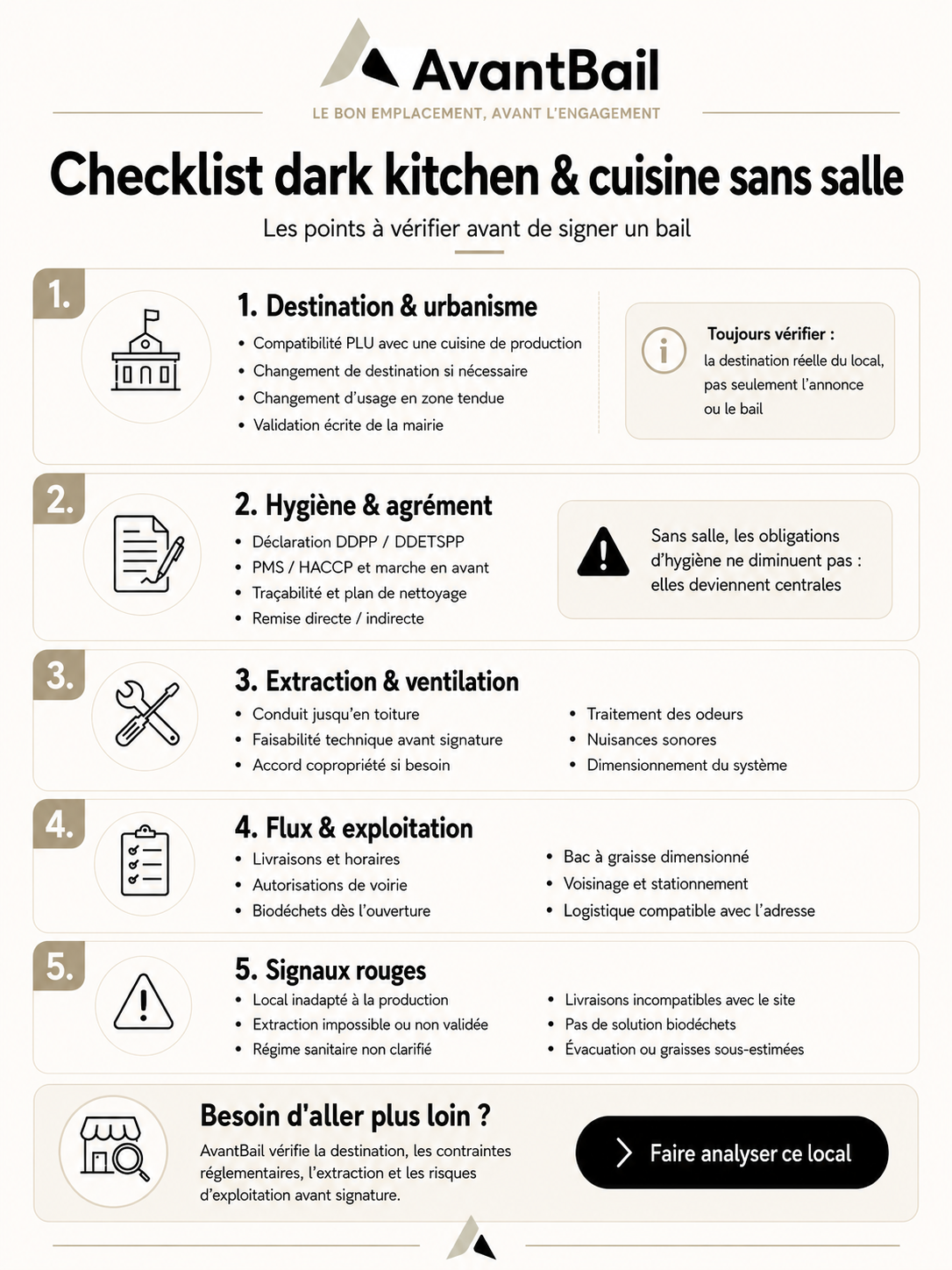
Dark kitchen / cuisine centrale
Avant d'ouvrir une dark kitchen ou une cuisine centrale sans salle, vérifiez la destination du local, l'agrément sanitaire, l'extraction, les obligations de livraison et le régime hors ERP applicable.
Open the checklistEnter your address to get a free preview — pick your trade when you start — or talk to an advisor directly.