Dark kitchen and cuisine centrale checklist: destination, hygiene, extraction and delivery to verify before you sign
Before opening a kitchen with no dining room, check a different regime — not a lighter one
A dark kitchen, a cuisine centrale (production kitchen) or a laboratoire (food-production unit) receives no customers on site: no dining room, no table service, often not even a sign visible from the street. This model lightens certain obligations specific to établissements recevant du public (ERP, venues open to the public), but it removes no verification before you sign — it simply shifts the centre of gravity.
With no dining room, there is no ERP classification, no accessibility obligation designed for on-site customers, no commission de sécurité (safety inspection board) to schedule, and no terrasse (pavement terrace) to authorise. In return, food hygiene, the agrément sanitaire (health approval), extraction without the cover of a restaurant dining room, delivery flows and the obligations specific to delivery platforms become the central points of vigilance.
The destination du local (planning use of the premises) remains a question in its own right: the premises must be compatible, under urban-planning rules, with a production-kitchen activity — which is neither automatic in an ordinary commercial unit, nor identical to the destination of a restaurant with a dining room.
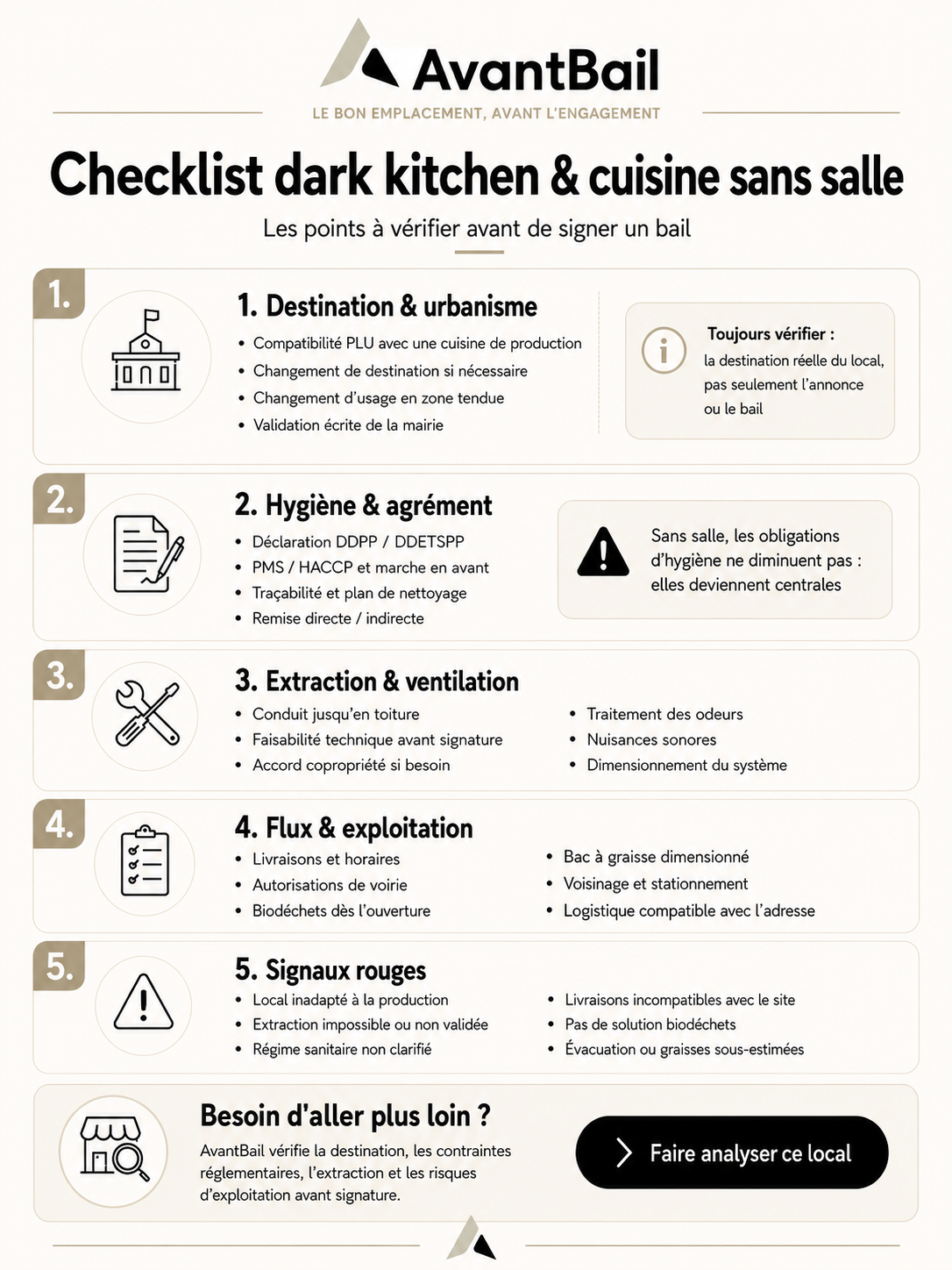
This AvantBail checklist helps identify the points to verify before signing a bail (commercial lease) or committing to premises dedicated to a kitchen with no dining room — dark kitchen, cuisine centrale, laboratoire de production, or a traiteur (caterer) operating delivery-only. It covers the whole of France; the exact contact (mairie / town hall, DDPP/DDETSPP, landlord, syndic / building manager) can vary by commune and by the setup chosen. It does not replace the advice of a professional-kitchen specialist, a lawyer or a chartered accountant.
The essentials
The essentials to remember
Before opening a kitchen with no dining room, four families of points must be verified.
A different regime, not a lighter one
No ERP, no customer accessibility (PMR), no commission de sécurité, no terrasse — but hygiene, the agrément sanitaire and delivery logistics become the central points.
The destination du local remains question no. 1
Even without a dining room, the premises must be compatible, under planning rules, with a production-kitchen activity — which is neither automatic, nor identical to the destination of a restaurant with a dining room.
Hygiene and the agrément sanitaire are central
HACCP, marche en avant (forward-flow / no cross-contamination), traceability, and the specific question of remise directe or indirecte (direct or indirect supply), which can trigger the requirement for an agrément sanitaire.
Flows and delivery platforms create their own obligations
Roadway/voirie, biodéchets (bio-waste), platform contracts, allergen and origin labelling: all points that do not exist in the same way for a restaurant with a dining room.
Who is this checklist for?
This checklist is aimed at:
- founders of a dark kitchen or a delivery-only kitchen;
- caterers switching to a model with no dining room and no on-site customers;
- operators of cuisines centrales that supply several points of sale;
- food-production laboratoires working B2B (public bodies, distributors, resellers);
- operators of multi-brand concepts (« virtual brands ») run from a single kitchen;
- investors assessing premises intended solely for production/delivery.
It covers concepts that receive no physical clientele on site — as opposed to the restaurant-opening and business-takeover checklists, which cover restaurants with a dining room.
Section 1 · Regulatory & logistics
The regulatory and logistical points to verify before opening a kitchen with no dining room
Destination du local and changement de destination or changement d'usage
Even with no dining room and no customers received on site, premises intended for a production kitchen must be compatible, under the plan local d'urbanisme (PLU, local urban plan) or the equivalent document, with an « artisanat » (craft) or « industrie » (industrial) destination — and not solely « commerce » (retail) or « bureau » (office). Premises originally assigned to an office, a retail shop or housing do not automatically become compatible with a production-kitchen activity: a changement de destination (change of planning use) may be required, with the agreement of the mairie and, depending on the case, a déclaration préalable (prior declaration) or a permis de construire (building permit).
In large conurbations in a zone tendue (high-demand housing area — Paris, Lyon, Bordeaux and other communes covered by a changement d'usage scheme), converting residential premises into a professional kitchen additionally requires a changement d'usage (change of use) authorisation, distinct from the changement de destination — a step frequently underestimated by dark-kitchen founders, who sometimes set up in former residential premises or low-value ground floors.
- Where
- With the urban-planning department of the mairie for the premises, to check the PLU zoning and any exposure to a changement d'usage scheme.
- When
- Before signing the bail or the promesse (preliminary agreement), never after starting fit-out works.
How
- check the destination and sub-destination authorised by the PLU for the parcelle (plot);
- identify the previous use of the premises (office, retail, housing, warehouse);
- check whether a changement de destination is required and which procedure it involves;
- check, in a zone tendue, whether a changement d'usage is also required, independently of the changement de destination;
- have the mairie confirm that the production-kitchen activity is explicitly compatible with the intended destination.
Warning — zone tendue
Paris, Lyon, Bordeaux and other communes make the conversion of residential premises into professional premises subject to a distinct changement d'usage authorisation, sometimes coupled with a compensation obligation. This step is independent of the changement de destination and must be verified separately.
To verify before signing
- does the PLU allow a craft/industrial kitchen activity on this parcelle?
- have the premises already hosted a comparable activity (food service, food craft)?
- is a changement de destination required, and has it been anticipated in the schedule?
- are the premises located in a commune subject to a changement d'usage scheme?
Proofs to keep on file
- certificat d'urbanisme (planning certificate) or urban-planning information note;
- written confirmation from the mairie on the compatible destination;
- changement d'usage authorisation if applicable;
- changement de destination order (arrêté) if required.
The AvantBail risk — premises leased for a production kitchen without a compatible planning destination can be served with a formal notice (mise en demeure), or even an administrative closure, once the activity has started.
With AvantBail
Before you sign, AvantBail checks the real planning destination of an address — including for premises with no dining room — to substantiate this point before you commit.
Check the destination of these premises →Agrément sanitaire, DDPP/DDETSPP declaration and the paquet hygiène
Any activity preparing foodstuffs — with or without a dining room — must be the subject of an activity declaration (déclaration d'activité) to the departmental directorate in charge of protecting the public (DDPP or DDETSPP), and must comply with the paquet hygiène (EU hygiene package): plan de maîtrise sanitaire (food-safety management plan), HACCP, marche en avant (forward flow), and traceability of raw materials and preparations.
The absence of a dining room removes none of these obligations — it often reinforces them, because there is no longer a customer's visual check on the final result: process compliance alone carries the trust. A specific point to verify is the nature of the supply to the customer: remise directe (direct supply — sale to the final consumer, including via delivery) follows a lighter regime, whereas remise indirecte (indirect supply — sale to an intermediary who resells or serves it in turn: partner restaurant, public body, another point of sale) can trigger the requirement for a European agrément sanitaire, depending on the share of the activity concerned and the volumes involved.
- Where
- The DDPP or DDETSPP of the department where you set up, for the déclaration d'activité and the exact qualification of the regime (remise directe/indirecte, EC agrément or dérogation).
- When
- Before actual opening; the déclaration d'activité must be made before production starts.
How
- declare the activity to the DDPP/DDETSPP before opening;
- draft, or have drafted, the plan de maîtrise sanitaire (HACCP) suited to a production activity with no dining room;
- have the DDPP/DDETSPP qualify the share of remise directe and remise indirecte planned by the business model;
- check whether a European agrément sanitaire is required, in particular in the event of sale to partner restaurants, public bodies or resellers;
- organise the marche en avant and traceability from the kitchen-plan design stage.
Point of vigilance — remise directe / indirecte
a dark kitchen or a cuisine centrale that delivers only to final consumers remains, in principle, in remise directe; as soon as a share of production is sold to professionals who resell or serve it in turn, the remise indirecte regime — and the possible agrément sanitaire — must be verified with the DDPP/DDETSPP before locking in the business model.
To verify before opening
- has the déclaration d'activité to the DDPP/DDETSPP been made?
- is the plan de maîtrise sanitaire (HACCP) drafted and suited to the activity?
- has the share of remise directe and remise indirecte of the business model been qualified?
- is a European agrément sanitaire required, given this qualification?
- is the marche en avant organised in the kitchen plan?
Proofs to keep on file
- DDPP/DDETSPP declaration receipt (récépissé);
- plan de maîtrise sanitaire;
- agrément sanitaire if applicable, or written confirmation of a dérogation;
- kitchen plan showing the marche en avant.
The AvantBail risk — underestimating the share of remise indirecte can, once the activity is running, force production to be halted while an agrément sanitaire that was not anticipated is obtained.
With AvantBail Ingénierie
AvantBail Ingénierie designs the kitchen layout — zones, marche en avant, flows — building in from the outset the hygiene and agrément constraints specific to an activity with no dining room.
Have my kitchen layout studied →Extraction and ventilation, without the cover of a restaurant dining room
As soon as there is cooking, the extraction of steam, grease and fumes remains mandatory — dining room or not. What changes is the context: in a restaurant with a dining room, extraction is often already anticipated by the landlord or the previous operator. In premises taken over for a kitchen with no dining room, this subject is frequently discovered after signing, for want of having been verified as a central point.
The extraction duct must generally exit at roof level, which requires the agreement of the copropriété (co-ownership) if the building has one, as well as a technical feasibility study. Odour and noise nuisances are often more sensitive for a dark kitchen: this type of concept frequently sets up in low-rent premises located in a residential area or at the foot of a residential building, where neighbours tolerate an extraction duct or continuous production poorly.
- Where
- With a kitchen ventilation/extraction specialist, the syndic de copropriété (building manager) if applicable, and the urban-planning department for the roof outlet.
- When
- Before signing the bail, before any fit-out is undertaken.
How
- have a professional assess the feasibility of an extraction duct up to roof level;
- check the copropriété's agreement in principle if the building has one;
- anticipate the treatment of odour nuisances (filters, air treatment) before commissioning;
- check the applicable noise thresholds (extraction motors, production equipment) with regard to the neighbours.
To verify before signing
- is an extraction duct up to roof level technically possible?
- has the copropriété given, or is it likely to give, its agreement?
- is odour treatment planned, particularly in a residential area?
Proofs to keep on file
- extraction feasibility study;
- agreement or opinion of the copropriété;
- quote or installation plan for the extraction/air-treatment system.
The AvantBail risk — a dark kitchen that starts up without compliant extraction is exposed to a formal notice from neighbours or the copropriété, with a possible activity stoppage while the duct is brought into compliance.
With AvantBail Ingénierie
Extraction is a subject AvantBail Ingénierie sizes concretely — duct, airflow, air treatment — before you sign a bail on premises that may not allow it.
Have the extraction of these premises assessed →Installations classées pour la protection de l'environnement (ICPE, classified environmental installations): a regime specific to food production at volume
A kitchen preparing foodstuffs at a volume higher than that of an ordinary restaurant may fall under the regulations on installations classées pour la protection de l'environnement (ICPE, classified environmental installations), which are added to — without replacing — the hygiene and planning obligations already verified. The ICPE nomenclature contains a family of headings dedicated to the preparation or preservation of foodstuffs of plant, animal or mixed origin by industrial-type processes (cooking, canning, deep-freezing in particular), with thresholds for déclaration, enregistrement or autorisation (declaration, registration or authorisation) that depend on the volume produced or the power of the installations.
The exact number of the applicable heading and the precise thresholds (daily or annual tonnage, power of the cooking or refrigeration installations) depend on the exact nature of the activity and change over time: this point must never be estimated from memory, by analogy with an ordinary restaurant, or from a figure read elsewhere. It must be confirmed, for each project, with the DREAL (regional directorate for the environment, planning and housing) or the préfecture of the department where you set up, before signing a bail or undertaking works.
- Where
- The DREAL or the préfecture of the department where you set up, for the exact qualification of the heading and the applicable threshold (déclaration, enregistrement or autorisation).
- When
- Before signing the bail, before locking in the targeted production volume and the power of the cooking and refrigeration equipment.
How
- have the DREAL or the préfecture qualify the production volume actually targeted (daily or annual tonnage);
- have the exact ICPE heading applicable to the activity confirmed, rather than relying on a memorised or approximate threshold;
- identify whether the applicable regime is simple déclaration, enregistrement or autorisation, each involving different steps and timescales;
- build the ICPE processing time, if required, into the project's opening schedule.
Point of vigilance — do not estimate this threshold yourself
the ICPE nomenclature thresholds applicable to the preparation of food products are read in tonnage or in installed power, not in number of covers or floor area, and they evolve: only the DREAL or the préfecture can confirm the exact regime applicable to a given project. This checklist deliberately cites no numerical threshold, precisely to avoid misleading on a point that must be verified case by case.
To verify before signing
- has the targeted production volume been checked against the ICPE nomenclature by the DREAL or the préfecture?
- has the applicable regime (déclaration, enregistrement, autorisation) been precisely identified?
- has any processing time been built into the opening schedule?
Proofs to keep on file
- written confirmation from the DREAL or the préfecture on the applicable ICPE regime;
- déclaration receipt, enregistrement file or autorisation file, depending on the confirmed regime.
The AvantBail risk — relying on an approximate estimate of the ICPE regime can delay opening by several months if an enregistrement or autorisation file turns out to be required once the activity is already under way — and no one, apart from the DREAL/préfecture, can certify this regime in advance.
With AvantBail
From the address and the project, AvantBail identifies the regulatory points of vigilance to have confirmed by the DREAL before you sign — without ever substituting for that official confirmation.
Check the points of vigilance for this project →Delivery, flows, voirie authorisations and the bac à graisse
A kitchen with no dining room concentrates most of its activity on inbound flows (raw materials, supply) and outbound flows (delivery to customers or partner points of sale). Parking for delivery vehicles, the presence of powered two-wheelers waiting, and loading/unloading hours may require a voirie (roadway) authorisation or be governed by a municipal order (arrêté municipal), particularly in dense urban areas.
The volume of biodéchets (bio-waste) produced by a production kitchen is often higher than that of an ordinary restaurant for the same floor area. Since 1 January 2024, every producer of biodéchets, whatever the quantity produced, must ensure tri à la source (sorting at source) and suitable recovery — a point to build into the operating plan from the design stage of the premises.
Independently of biodéchets, a production kitchen at volume most often needs a bac à graisse (grease trap / separator) correctly sized for its discharge flow, with a regular maintenance and emptying contract. This is an obligation distinct from biodéchets collection, and a point frequently under-sized in premises converted from a use that was not designed for food production.
- Where
- The mairie (voirie department, municipal police) for parking/delivery authorisations; the local authority or an approved provider for biodéchets collection; a professional-kitchen specialist for sizing the bac à graisse.
- When
- Before opening, ideally anticipated in the very choice of premises (delivery-rider access, nearby parking area, existing drainage network).
How
- check for the existence of a municipal order governing deliveries (hours, parking, two-wheelers) at the premises' address;
- identify whether a voirie authorisation is required for loading/unloading;
- anticipate nuisances linked to night-time or peak-hour deliveries with regard to the neighbours;
- put in place, from opening, tri à la source and a biodéchets collection solution suited to the volume produced;
- check the presence and sizing of a bac à graisse suited to the planned discharge flow, and organise its regular maintenance.
To verify before opening
- does a municipal order govern deliveries at this address?
- is a voirie authorisation required for loading/unloading?
- is a biodéchets collection solution planned from opening?
- are the planned delivery hours compatible with the neighbours?
- is a bac à graisse sized for the production volume installed and maintained regularly?
Proofs to keep on file
- applicable municipal order, where relevant;
- voirie authorisation if required;
- biodéchets collection contract;
- maintenance and emptying contract for the bac à graisse.
The AvantBail risk — poorly anticipated deliveries — impossible parking, prohibited hours — can slow the activity from the first weeks and expose it to municipal sanctions; an absent or under-sized bac à graisse additionally exposes it to pipe blockages and non-compliance with the sewerage network.
With AvantBail
From the address, AvantBail substantiates the observable voirie and access constraints around premises before you commit to them for a delivery activity — and directs you to AvantBail Ingénierie for the technical sizing of the bac à graisse and the networks.
Check the access to these premises →Delivery platforms: contractual obligations and labelling
Working through one or more delivery platforms (listing, commission, possible exclusivity) is a commercial contract to read carefully before signing: commission rate, commitment period, termination conditions, and clauses on visibility or promotion within the app.
Independently of the contract with the platform, the legal labelling obligations — origin of meats, statement of allergens, nutritional information where required — apply to distance selling just as to on-site selling. A kitchen with no dining room that displays this information only on its own site, without carrying it over onto every product listing of the platforms used, remains in breach.
- Where
- The contract with each delivery platform; the general regulations on the labelling of allergens and the origin of meats, applicable whatever the sales channel.
- When
- Before signing a listing contract with a platform, before publishing the product listings.
How
- read in full the contract of each platform before signing (commission, term, exclusivity, termination);
- check that each product listing on each platform states the regulatory allergens;
- check that the origin of meats is displayed in accordance with the regulations, including in distance selling;
- anticipate the impact of any exclusivity clause on the ability to work with other sales channels.
To verify before listing your activity
- are the commission rate and the commitment period of each platform known?
- does an exclusivity clause limit recourse to other channels?
- are allergens stated on every product listing of every platform?
- is the origin of meats displayed in accordance with the regulations?
Proofs to keep on file
- signed contract with each platform;
- screenshots of the product listings with allergen/origin statements;
- commission rate schedule.
The AvantBail risk — a poorly anticipated exclusivity clause can block the multi-channel development of the concept, and a product listing with no allergen statement exposes you to a sanction independently of the contract with the platform.
With AvantBail
This contractual point goes beyond the address pré-diagnostic; AvantBail helps you structure the right questions before you commit with one or more platforms.
Discuss my delivery model →Hors ERP in principle — except for a collection point, counter or direct sale open to the public
Premises that receive no physical clientele are, in principle, not classified as an établissement recevant du public (ERP, venue open to the public): no commission de sécurité to schedule, no accessibility obligation designed for customers, no commission report (procès-verbal) to obtain before opening.
This hors-ERP status rests on a precise assumption: no clientele enters the premises. As soon as a collection counter, a click-and-collect point, or any space where the public waits or is physically received is added to the plan — even occasionally or secondarily — the question of ERP classification becomes one to verify again: the presence, even minimal, of a public reception can be enough to tip the premises into an ERP regime, with its own accessibility and safety obligations. This point is decided case by case with the mairie or a professional, depending on the exact plan of the premises — it is never presumed ruled out as a matter of principle.
Outside that scenario, the premises remain a workplace (lieu de travail) within the meaning of the labour code: fire safety and staff evacuation, sizing of exits according to headcount, compliance of the electrical installations, safety register (registre de sécurité) and, depending on headcount, evacuation drills. This is a different regime from that of an ERP — not an absent one.
- Where
- The mairie, to decide whether a collection counter or a click-and-collect point tips the premises into ERP; the labour inspectorate or an occupational-risk-prevention professional for the obligations applicable to workplaces.
- When
- Before opening, and at every significant change to the plan (adding a counter or a collection point), the headcount or the fit-out of the premises.
How
- confirm that no clientele is physically received in the premises, the condition for the hors ERP regime;
- if a collection counter or a click-and-collect point is envisaged, have the mairie decide whether this contact point tips the premises into ERP;
- check that the premises meet the fire-safety rules applicable to workplaces (exits, smoke extraction, extinguishers);
- have the compliance of the electrical installations checked by a professional;
- keep the safety register (registre de sécurité) and organise the evacuation drills required according to headcount;
- do not confuse this regime with that of an ERP: no ERP classification procedure is to be undertaken as long as no public is received.
To verify before opening
- is a collection counter, a click-and-collect point or a public waiting area planned, even secondarily?
- if so, has the mairie ruled on the applicable ERP classification?
- do the premises comply with the fire-safety rules applicable to workplaces?
- have the electrical installations been checked by a professional?
- is a safety register (registre de sécurité) kept?
- are the evacuation drills required according to headcount organised?
Proofs to keep on file
- electrical inspection report;
- safety register (registre de sécurité);
- record of the evacuation drills, where relevant.
The AvantBail risk — confusing « no ERP » with « no safety obligation » exposes the employer to liability in the event of an accident, independently of any rule specific to venues open to the public.
With AvantBail
For a given address, AvantBail clarifies the regime that actually applies — ERP or workplace — to avoid false certainties before you sign.
Clarify the regime applicable to these premises →Alcohol: no licence de débit de boissons, except for delivered alcohol
With no clientele received on site, the licence de débit de boissons (drinks-outlet licence) — the one for restaurants and bars with a dining room — normally has no reason to be applied for. The only exception: if the business model provides for delivering alcohol to accompany meals, a declaratory regime distinct from takeaway sale then applies, to be confirmed at the mairie case by case — without confusing the two regimes.
The AvantBail risk — confusing this regime with that of a restaurant with a dining room wastes time on a pointless step, or conversely causes you to miss a declaration that is genuinely required if delivered alcohol is planned.
With AvantBail
This point is confirmed at the mairie case by case; from the address and the planned business model, AvantBail substantiates the regimes that actually apply before you sign.
Check this point before you sign →Copropriété and commercial lease: the destination remains enforceable, even without a dining room
A règlement de copropriété (co-ownership rules) can restrict or prohibit a kitchen activity — extraction noise, odours, delivery hours — even in the absence of any dining room and any clientele received on site. The absence of the public does not set aside the building's destination clauses or the clauses relating to nuisances.
The bail commercial (commercial lease) itself must be read with the same care as for a restaurant with a dining room: a generic « commerce » lease can explicitly exclude food service or a kitchen activity, or authorise only office or warehouse use. The lease's destination must correspond precisely to a production-kitchen activity — dark kitchen, cuisine centrale, laboratoire — and not be inferred by extension from a general « commerce » clause.
- Where
- The règlement de copropriété (syndic) and the bail commercial (landlord), to be read before signing.
- When
- Before signing the bail or the promesse.
How
- request and read the règlement de copropriété, in particular the destination and nuisance clauses;
- check that the lease's destination clause explicitly mentions a production-kitchen activity;
- check whether a déspécialisation (change of authorised lease activity) is required if the lease covers only office, warehouse or generic retail use;
- anticipate the copropriété's likely reaction to an extraction duct or frequent deliveries.
To verify before signing
- does the règlement de copropriété allow a kitchen activity at this address?
- does the lease's destination clause explicitly cover a production kitchen?
- is a déspécialisation required?
- have the expected nuisances (extraction, deliveries) been anticipated with regard to the copropriété?
Proofs to keep on file
- règlement de copropriété;
- commercial lease and amendments (avenants);
- written agreement of the landlord or the syndic if required.
The AvantBail risk — a production kitchen set up without a compatible destination in the copropriété can be forced to cease activity on a simple formal notice (mise en demeure), independently of the validity of the lease itself.
With AvantBail
AvantBail cross-checks the lease's destination and the observable copropriété constraints against the activity actually planned, before you sign.
Check the compatibility of this lease →Production sizing and multi-brand consistency
The sizing of a kitchen with no dining room — production area, number of stations, cold-storage capacity, cooking capacity — must be checked against the order volume actually achievable in the targeted delivery zone, and not set against a generic standard for a restaurant with a dining room, which does not have the same flow logic.
The « multi-brand » model (several concepts run from a single kitchen) can improve the profitability of premises, but it presupposes a production organisation that absorbs several menus without degrading either lead times or the hygienic marche en avant. This sizing cannot be automated: it is the remit of a kitchen-equipment professional, not of an address pré-diagnostic.
Running several virtual brands from a single kitchen remains, most of the time, a marketing choice (several names, several visual identities) that changes nothing in the legal structure: the same SIRET, the same premises. But depending on the activities actually carried out under each brand, a distinct NAF declaration or a specific mention to the DDPP/DDETSPP may prove necessary — a point to have confirmed case by case, rather than assumed settled by the sole choice of several trade names.
- Where
- With a professional-kitchen design specialist, to size the production against the real business model.
- When
- Before signing the bail, before locking in the kitchen fit-out plan.
How
- check the planned area and equipment against the order volume actually targeted in the delivery zone;
- have a professional verify whether the premises allow several brands to be run without degrading the marche en avant;
- anticipate the cold-storage capacity needed for the planned production volume;
- do not validate a generic kitchen plan without checking it against the project's real business model.
To verify before locking in the fit-out
- does the planned production capacity match the order volume actually achievable?
- do the premises allow several brands to be run without degrading lead times or hygiene?
- is the cold-storage capacity sufficient for the planned volume?
- has a kitchen-equipment professional validated the fit-out plan?
- if several brands are run from the same kitchen, has a distinct NAF declaration or a DDPP/DDETSPP mention been verified for each?
Proofs to keep on file
- kitchen fit-out plan;
- sizing note drawn up by a professional;
- study of order volumes by delivery zone, if available.
The AvantBail risk — under-sizing production limits growth from the first months; over-sizing needlessly ties up capital in premises with no dining room that generate no cover revenue.
With AvantBail Ingénierie
AvantBail Ingénierie sizes the kitchen against the volume actually targeted — production, cold storage, multi-brand — before you lock in the lease or the works.
Have my kitchen sized →Section 2 · Recap
Quick recap — the essential points of a kitchen with no dining room at a glance
| Point to verify | Where / with whom? | Risk if overlooked |
|---|---|---|
| PLU destination (craft/industrial) | Mairie (urban planning) | Non-compliant activity discovered after signing |
| Changement d'usage in a zone tendue | Mairie | Missing authorisation for former housing converted into a kitchen |
| Règlement de copropriété | Syndic | Activity challenged or prohibited after set-up |
| Lease destination clause | Landlord | Lease not explicitly covering a production kitchen |
| Point to verify | Where / with whom? | Risk if overlooked |
|---|---|---|
| Déclaration d'activité | DDPP/DDETSPP | Activity not declared before opening |
| Share of remise directe / indirecte | DDPP/DDETSPP | Missing agrément sanitaire if selling to professionals |
| Roof-level extraction duct | Copropriété, ventilation professional | Nuisances, formal notice from neighbours |
| ICPE regime by production volume — heading and threshold to confirm | DREAL or préfecture | Classification omitted at activity start-up, opening delay |
| Point to verify | Where / with whom? | Risk if overlooked |
|---|---|---|
| Voirie / delivery authorisation | Mairie (voirie) | Impossible parking, municipal sanctions |
| Bac à graisse and connection | Copropriété, sewerage department | Network blockage, formal notice |
| Biodéchets collection | Approved provider | Non-compliance with mandatory tri à la source |
| Collection point or direct sale open to the public | Mairie (urban planning, ERP) | Unanticipated reclassification as ERP |
| Delivery-platform contract | Platform | Poorly anticipated commission or exclusivity |
| Workplace fire safety | Labour inspectorate | Employer liability engaged in the event of an accident |
| Delivered-takeaway alcohol regime | Mairie | Missing declaration if an alcohol offer is planned |
Section 3 · Documents
Documents to gather before opening a kitchen with no dining room
Before signing the bail or starting the activity, gather at least:
- certificat d'urbanisme (planning certificate) or urban-planning information note
- written confirmation from the mairie on the compatible destination
- changement d'usage authorisation if the premises are in a zone tendue and of residential origin
- DDPP/DDETSPP déclaration d'activité receipt (récépissé)
- plan de maîtrise sanitaire (HACCP)
- European agrément sanitaire if a share of remise indirecte is planned
- extraction feasibility study and copropriété agreement
- written confirmation from the DREAL or the préfecture on the applicable ICPE regime
- municipal order (arrêté municipal) governing deliveries, if applicable
- installation and maintenance certificate for the bac à graisse
- biodéchets collection contract
- signed contracts with each delivery platform
- règlement de copropriété
- commercial lease and amendments (avenants)
- electrical-installation inspection report
- workplace safety register (registre de sécurité)
- kitchen fit-out plan and sizing note
Section 4 · Pitfalls
The common mistakes before opening a kitchen with no dining room
1. Confusing « no dining room » with « no rules »
The workplace regime still applies: fire safety, electrical installations, safety register. It is not a lighter regime, it is a different one.
2. Underestimating the share of remise indirecte
Selling to partner restaurants, public bodies or resellers can trigger the requirement for an agrément sanitaire, discovered all too often after the activity has launched.
3. Neglecting extraction for want of a dining room to « cover »
A roof-level extraction duct remains mandatory as soon as there is cooking, with or without a dining room. The copropriété's agreement must be verified before signing, not after the works.
4. Estimating the ICPE threshold yourself rather than having it confirmed
The classified-installations regime depends on a production volume and a precise heading, specific to each project. An approximate estimate — rather than written confirmation from the DREAL or the préfecture — can delay opening by several months if the real classification is discovered after signing.
5. Forgetting that a collection point or a direct sale changes everything
A kitchen with no dining room is not an ERP in principle, but as soon as a counter, a collection point or a sale open to the public exists, ERP qualification becomes possible again. This point must be verified at the mairie before adding any customer reception, however minimal.
6. Forgetting the lease destination clause or the règlement de copropriété
The règlement de copropriété can restrict the activity (extraction noise, odours, deliveries), and the lease's destination clause must explicitly mention a production-kitchen activity — a generic « commerce » lease can exclude it. Both documents are read before signing, not after.
7. Under-sizing the bac à graisse or waste management
Production at volume generates greasy effluent and biodéchets far greater than those of an ordinary restaurant. An under-sized bac à graisse or an absent biodéchets collection exposes you to a formal notice from the copropriété or the sewerage department.
8. Confusing the delivered-takeaway alcohol regime with the licence de débit de boissons
Applying for a pointless licence wastes time; forgetting the declaration genuinely required for delivered alcohol exposes you to non-compliance.
9. Sizing the kitchen against a generic restaurant-with-dining-room standard
The flow logic of a delivery-only kitchen is not that of a restaurant with a dining room: the sizing must be checked against the real order volume targeted, including if several virtual brands share the same kitchen.
Section 5 · Timing
When to have a kitchen with no dining room verified?
It is recommended to have this type of project verified:
- before signing the bail or the promesse;
- before having the applicable ICPE regime confirmed by the DREAL or the préfecture;
- before undertaking any fit-out or extraction works;
- before declaring the activity to the DDPP/DDETSPP;
- before listing your activity on one or more delivery platforms;
- before locking in the kitchen plan and its sizing;
- before any changement de destination or changement d'usage request;
- before communicating an opening date to your partners or investors.
The right moment is not after signing. The right moment is before you commit.
Receive the complete dark kitchen checklist by e-mail
This page covers the essential points of a kitchen with no dining room. The complete checklist — with the checkboxes, the points of vigilance and the questions to ask the mairie, the DDPP/DDETSPP or a kitchen professional — is sent to you directly by e-mail. If the project already has an address, AvantBail can go further.
The complete checklist includes:
- the regime that actually applies in the absence of a dining room (ERP, PMR, terrasse)
- the planning-destination and changement d'usage points
- the points of vigilance to have confirmed on the ICPE regime
- the hygiene and agrément sanitaire obligations, remise directe/indirecte
- extraction, the bac à graisse and the copropriété points of vigilance
- the obligations specific to deliveries and platforms
- the questions to ask before signing a bail or a platform contract
- the most frequent warning signs
- checkboxes
The right location, before you commit.
Have you identified premises for your kitchen with no dining room?
AvantBail analyses an address before signing — destination, zoning, probable copropriété constraints — and AvantBail Ingénierie sizes the kitchen itself — extraction, production, cold storage — so that your dark kitchen or cuisine centrale project holds up before you commit.
Important note
This checklist does not replace a professional-kitchen specialist, a lawyer or a chartered accountant. It serves to identify the points of vigilance before signing a bail or starting a kitchen activity with no dining room, not to validate a project legally, in health-and-safety terms or financially. The exact obligations — destination, agrément sanitaire, extraction, delivery — can vary by commune, by premises and by the business model chosen.