
Restaurant takeover checklist: fonds de commerce (business asset), lease, debts and permits to check before you sign
Before taking over a restaurant, check what you are really buying
Taking over an existing restaurant is not the same operation as opening one in an empty space. A takeover comes with a history: a bail commercial (commercial lease) already committed to by a third party, debts possibly attached to the fonds de commerce (the business as a going concern — clientele, trade name, lease rights, equipment), permits that follow — or do not follow — the previous operator, equipment already in place, and often staff already employed.
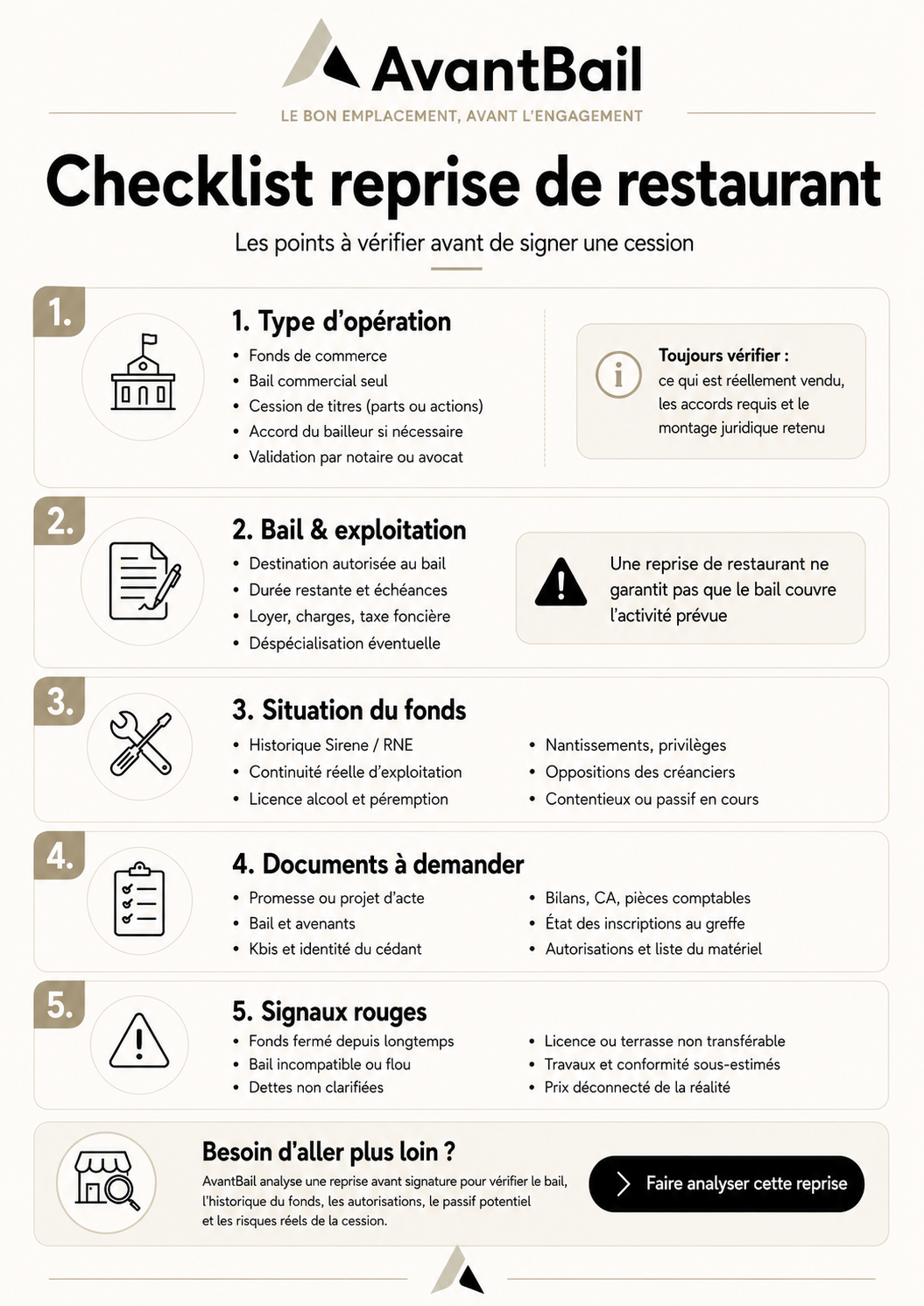
Before signing, you first need to understand what is really being offered for sale: a cession de fonds de commerce (sale of the business asset), a cession de bail seul (sale of the lease only), or a cession de titres (sale of company shares) — parts sociales or actions — of the company operating the restaurant. These three operations do not have the same object, the same risks, or the same verification procedure.
A takeover can seem faster and safer than opening from scratch, because the business already exists. But it can also pass on debts (dettes du fonds), employment liabilities (passif social), permits to renew or lease constraints that only surface after signing.
This AvantBail checklist helps you identify what to check before signing a promesse (preliminary agreement) or a cession deed. It applies to taking over a restaurant anywhere in France; the exact contact (mairie, greffe / commercial court registry, DDPP, landlord, syndic) can vary by commune, département and the nature of the operation. It does not replace the advice of a notaire, a lawyer or a chartered accountant (expert-comptable) on the transaction itself.
The essentials
Key takeaways
Before taking over a restaurant, you need to check four families of risk.
Which transaction are you really taking on?
Fonds de commerce, lease only or company shares (titres): these three structures do not carry the same liability, the same checks, or the same need for the landlord's consent.
The legal and financial continuity of the fonds
Debts, privilèges (preferential claims), nantissements (pledges), the creditors' opposition procedure, ongoing litigation: a takeover can pass on liabilities that are invisible at first glance.
The permits that do — or do not — follow the operator
Alcohol licence, terrasse, signage, ERP: some permits transfer with the fonds, others are personal to the previous operator and must be applied for again.
The economic soundness of the takeover
The asking price, the equipment taken over, the works to plan and the real chiffre d'affaires (turnover) must be compared before signing, not after.
Who is this checklist for?
This checklist is intended for:
- buyers of a restaurant fonds de commerce;
- buyers of a bail commercial already operated as a restaurant;
- buyers of shares — parts sociales or actions — in an operating company;
- franchisees taking over an existing branded restaurant;
- investors buying a business already in operation;
- specialist estate agents handling a cession;
- sellers (cédants) who want to secure their own cession.
It covers the takeover of a restaurant, brasserie, bistro or food service concept already in operation — as opposed to opening a restaurant in a space that had no prior food service activity.
Section 1 · Legal & financial
The legal and financial points to check before taking over a restaurant
Sale of the fonds de commerce, sale of the lease only, or sale of shares: three different operations
A restaurant takeover can take three different legal forms, which do not concern the same object and do not entail the same checks: the sale of the fonds de commerce (clientele, trade name, lease rights, equipment), the sale of the droit au bail alone (the leased premises, without the other elements of the fonds), or the cession de titres — parts sociales or actions — of the company operating the restaurant.
In a cession de fonds de commerce, the landlord cannot oppose the transfer of the business itself: any lease clause forbidding it is deemed unwritten (réputée non écrite). In a cession de bail seul, the landlord's prior written consent is almost always required. In a cession de titres, it is the company that remains the tenant: its identity as tenant does not change, and the landlord in principle has no say over the buy-out of the shares.
- Where
- The type of operation must be identified from the promesse or the takeover offer onwards, with the help of a notaire or a lawyer, before any price negotiation.
- When
- Before signing any promesse, before paying a deposit or down payment.
How
- identify precisely what is being sold: the fonds, the lease only, or company shares;
- check whether the bail allows or restricts the intended cession;
- check whether the landlord's consent is required and, if so, obtain it in writing;
- have the exact nature of the operation confirmed by a notaire or a lawyer before signing.
To check before signing
- is it a fonds de commerce, a lease only, or company shares (titres)?
- does the bail allow the intended cession?
- must the landlord give written consent?
- has the legal structure of the takeover been confirmed by a professional?
Proofs to keep on file
- promesse de cession or purchase agreement;
- draft deed specifying the nature of the operation;
- landlord's written consent if required;
- notaire's or lawyer's opinion on the chosen structure.
The AvantBail risk — confusing these three operations can waste months of negotiation, or reveal after signing obligations that the chosen structure did not allow you to anticipate.
With AvantBail
Before you commit, AvantBail helps you place your takeover project in its real context — address, bail, declared activity — so you can ask your notaire or lawyer the right questions.
Check the premises before signing →Current commercial lease: term, permitted use and condition report
Taking over a restaurant most often means taking over a bail already signed by a third party, with its remaining term, its clauses and its history. This lease must be read in full before valuing the takeover.
The destination of the lease — the activity it actually permits — must match the intended concept. A lease that permits « restauration » does not necessarily permit alcohol, extraction, a terrasse or delivery: these uses must be checked clause by clause, just as for a new opening.
- Where
- In the bail itself and its amendments (avenants), and with the landlord or their agent for any clarification.
- When
- Before signing the promesse de cession, never after.
How
- read the remaining term of the bail and its next three-year (triennale) break date;
- check the destination clause and its consistency with the intended concept;
- identify whether a déspécialisation (change or extension of permitted use) will be needed;
- check the rent uncapping (déplafonnement) clause and its impact at the next renewal;
- request the incoming and outgoing condition reports (états des lieux) from the seller, if available;
- check the amount of the rent, the charges, the re-invoiced property tax (taxe foncière) and the security deposit;
- check whether any compliance works remain the tenant's responsibility.
Watch out — déspécialisation
if the intended activity does not exactly match the destination of the bail, a déspécialisation procedure must be started with the landlord, who may then ask for a rent increase or a compensation payment.
To check before signing
- what is the remaining term of the bail?
- does the destination really permit the intended concept?
- is a déspécialisation needed?
- is the rent capped or uncapped (déplafonné) at the next renewal?
- is the incoming état des lieux available?
- is the security deposit kept, refunded or passed on?
Proofs to keep on file
- bail and avenants;
- état des lieux;
- recent rent and charges receipts (quittances);
- re-invoiced taxe foncière notice;
- déspécialisation agreement if needed;
- certificate confirming no unpaid rent.
The AvantBail risk — a lease about to expire, an incompatible destination or a poorly anticipated déplafonnement clause can turn an apparently safe takeover into a fragile project within the first few years.
With AvantBail
AvantBail compares the destination of the bail with the activity actually planned, to flag a point of concern before you commit.
Check lease compatibility →SIRENE history and continuity of operation
The history of the fonds in the SIRENE register lets you check the real continuity of operation: dates of creation, cessation or removal (radiation) of the establishment, and any succession links (liens de succession) between the predecessor and the current seller.
A fonds that has been closed for a long time may have lost part of its clientele and footfall — two elements that make up the value of the fonds de commerce. An alcohol licence (licence de débit de boissons) attached to an establishment that is not being operated can also lapse (péremption) after five consecutive years of closure, which would cause the buyer to lose the benefit of it.
- Where
- In the establishment's SIRENE/RNE data (available via official services or via an address pre-diagnostic) and, if in doubt, from the greffe of the commercial court.
- When
- Before valuing the fonds, before signing the promesse.
How
- check the date of creation and, where applicable, cessation of the establishment;
- identify any liens de succession (change of operator with no real interruption);
- check how long the fonds has really been in operation, or closed;
- check whether an alcohol licence is attached to the fonds and, if so, how long it has been unused.
Watch out — licence lapse (péremption)
an alcohol licence that goes unused for five consecutive years lapses; the buyer may no longer be able to benefit from it if this is not checked before signing.
To check before signing
- is the fonds really in operation, or has it been closed for some time?
- does an interruption of operation appear in the history?
- is an alcohol licence attached to the fonds?
- how long has that licence been unused, if applicable?
Proofs to keep on file
- SIRENE/RNE extract for the establishment;
- up-to-date Kbis extract of the seller;
- proof of the date of last effective operation;
- copy of the existing licence if applicable.
The AvantBail risk — a fonds reputed to be « in operation » on paper may in fact have been closed for a long time: the buyer then inherits a lost clientele, an overstated value, and sometimes an already-lapsed licence.
With AvantBail
The AvantBail pre-diagnostic cross-checks the history available for the address to flag an inconsistency between the declared activity and the activity actually observed.
Check the address history →Debts, privilèges and nantissements attached to the fonds
A fonds de commerce may be encumbered by a nantissement (pledge) or a privilège (preferential claim) securing a seller's debt that has not yet been settled. The law sets up a procedure to protect the buyer: the sale must be published in a journal of legal notices and then in the BODACC (the official bulletin of civil and commercial notices) within fifteen days of the deed, which opens a ten-day period for the seller's creditors, from that publication, to lodge an opposition to payment of the price.
Until that period has run its course, the sale price cannot be freely released to the seller: creditors who came forward within that period can block the payment, demand to be paid out of the price, or make a higher bid (surenchère). This is why the sale price is generally held in escrow (séquestre) — often by the notaire — during this period.
- Where
- At the greffe of the commercial court (état des inscriptions — the record of nantissements and privilèges on the fonds), and via the legal publication + BODACC arranged by the notaire at the time of the cession.
- When
- Before signing the final deed; the price escrow continues after signing, for as long as the opposition period runs.
How
- request an état des inscriptions (nantissements, privilèges) from the greffe of the commercial court;
- check that there is no insolvency proceeding (procédure collective) in progress against the seller;
- have the notaire arrange the legal publication and the BODACC publication of the cession;
- check that the sale price remains in escrow (séquestre) during the creditors' opposition period;
- request the release (mainlevée) of any registrations before the price is unblocked.
Procedural point
the creditors' opposition period is ten days from publication in the BODACC; the day of publication does not count, and the period is extended to the next day if it expires on a Sunday or public holiday.
To check before signing the final deed
- has an état des inscriptions of the fonds been requested from the greffe?
- is a procédure collective in progress against the seller?
- is the legal and BODACC publication planned by the notaire?
- will the sale price be held in escrow during the opposition period?
Proofs to keep on file
- état des inscriptions from the greffe;
- certificate confirming no procédure collective;
- proof of publication in the journal of legal notices;
- proof of publication in the BODACC;
- escrow agreement (convention de séquestre) for the sale price.
The AvantBail risk — taking over a fonds without clearing the registrations and the opposition period exposes the buyer to having the price blocked, or to being liable for debts attached to the fonds that they thought they were acquiring free of any liabilities.
With AvantBail
This type of verification is a matter for the notaire or lawyer arranging the cession; upstream, AvantBail helps you objectify the real parameters of the location and the business, before you enter this legal-securing phase.
Document this takeover →Permits transferred or to be renewed
A takeover does not automatically transfer all of the previous operator's permits. Some follow the fonds or the building; others are personal to the previous operator and must be applied for again in the buyer's name.
The alcohol licence in principle transfers with the fonds, but its transfer (mutation) must be declared to the mairie in the new operator's name. A sanitary approval (agrément sanitaire), if one exists, must also be checked. The ERP classification in principle follows the building, but a change of operator requires reviewing the predecessor's opening order (arrêté d'ouverture) and the report of the safety commission (commission de sécurité), and can trigger a new inspection if the premises have stayed closed for more than ten months or if works are planned. The permit to occupy public land (autorisation d'occupation du domaine public — terrasse, display) is personal and non-transferable: it ends automatically on the sale of the fonds, and the buyer must apply for a new one.
- Where
- Mairie (licence transfer declaration, ERP, terrasse), DDPP/DDETSPP (agrément sanitaire), greffe (if the licence is listed in the fonds inventory).
- When
- The licence transfer declaration must be made before the buyer effectively starts operating; the application for a new terrasse permit must be anticipated before the takeover, with no guarantee it will be granted automatically.
How
- check which permits really exist in the seller's name;
- declare the transfer (mutation) of the alcohol licence to the mairie;
- review the ERP arrêté d'ouverture and the latest commission de sécurité report;
- check whether the premises have stayed closed for more than ten months, which may require a new opening authorisation;
- apply, upstream, for a new autorisation d'occupation du domaine public in your name if a terrasse is planned;
- check the agrément sanitaire if the activity depends on it.
To check before signing
- which permits are really in the seller's name?
- can the alcohol licence be transferred (muté) into your name?
- are the ERP arrêté d'ouverture and the commission de sécurité report available?
- have the premises stayed closed for more than ten months?
- is the current terrasse covered by a transferable permit, or will it have to be re-applied for?
- is an agrément sanitaire needed and, if so, up to date?
Proofs to keep on file
- copy of the existing licence;
- transfer declaration (déclaration de mutation);
- predecessor's ERP arrêté d'ouverture;
- report of the safety and accessibility commission;
- existing autorisation d'occupation du domaine public;
- agrément sanitaire if applicable.
The AvantBail risk — a buyer may discover after signing that the terrasse that kept the restaurant alive is no longer authorised in their name, or that the alcohol licence has lapsed: these are elements of the fonds's value that must be checked before, not after.
With AvantBail
From the address, AvantBail helps distinguish what is probably transferable from what will have to be re-applied for — so you can objectify this point before you finalise the price.
Check the permits for this address →Condition of the equipment taken over
The equipment taken over (kitchen, refrigeration, extraction, furniture) is part of the value of the fonds, but its real condition and ownership must be checked separately from the advertised price.
Some equipment may belong to the landlord, be under a lease-finance arrangement (crédit-bail) or be the subject of a rental contract separate from the fonds: in that case it does not belong to the seller and cannot be sold with the fonds without lifting those contracts.
- Where
- From the seller (inventory, invoices, crédit-bail contracts) and, for technical compliance, from a professional-kitchen specialist.
- When
- Before signing: the inventory and its condition must be annexed to the cession deed.
How
- request a detailed contractual inventory of the equipment taken over;
- check the real ownership of each item: seller, landlord, or crédit-bail provider;
- have the working condition and compliance of sensitive equipment checked (cold rooms, extraction, hood, cooking appliances);
- identify worn or non-compliant equipment that will need replacing in the short term;
- cost the upgrade budget if needed.
To check before signing
- is the inventory of the equipment taken over precise and dated?
- does each item really belong to the seller?
- are any crédit-bail or rental contracts in force on equipment presented as included?
- are the extraction, refrigeration and cooking equipment working and compliant?
- has an upgrade budget been anticipated?
Proofs to keep on file
- contractual inventory annexed to the deed;
- purchase invoices or crédit-bail contracts;
- equipment maintenance records;
- a professional's report if an inspection was carried out.
The AvantBail risk — a fonds may show an impressive equipment inventory, while part of that equipment belongs to a third party or needs immediate replacement — which changes the economic reality of the takeover.
With AvantBail Ingénierie
AvantBail Ingénierie audits the equipment taken over — condition, compliance, real ownership — to objectify what you are really taking on before you validate the price.
Request an audit of the equipment →The commune's commercial pre-emption right
In some communes, the municipal council has defined a périmètre de sauvegarde du commerce et de l'artisanat de proximité (protection perimeter for local shops and crafts). Within this perimeter, any sale for value of a fonds de commerce, an artisanal business or a bail commercial is subject to the commune's pre-emption right (droit de préemption).
The seller must then send the commune a prior declaration (déclaration préalable) specifying the price, the activity the buyer intends, the seller's employees and the terms of the cession. The commune has a two-month period to decide: after that, its silence counts as a waiver and the sale can go ahead on the declared terms.
- Where
- From the mairie of the commune where the premises are located, to check whether the address is included in a périmètre de sauvegarde du commerce et de l'artisanat de proximité.
- When
- Before signing the final deed; the déclaration préalable and the two-month period must be cleared beforehand.
How
- check whether the address is within a périmètre de sauvegarde du commerce et de l'artisanat de proximité;
- if so, have the seller prepare the déclaration préalable de cession, with the notaire's help;
- wait for the two-month period to expire or for the commune's express consent;
- check that no pre-emption decision has been notified before signing.
To check before signing
- is the address located within a périmètre de sauvegarde du commerce et de l'artisanat de proximité?
- has the déclaration préalable to the commune been made, if required?
- has the two-month period expired with no reply, or has the commune expressly waived its right?
- has no pre-emption decision been notified?
Proofs to keep on file
- confirmation from the mairie on the applicable perimeter;
- déclaration préalable de cession;
- acknowledgement of receipt from the mairie;
- certificate of waiver or non-pre-emption.
The AvantBail risk — signing a cession without clearing this pre-emption right exposes you to the sale being void if the commune was not properly informed beforehand.
With AvantBail
From the address, AvantBail identifies whether the premises sit in an area subject to specific municipal schemes, to steer your questions to the notaire before signing.
Check the status of this address →Litigation and employment liabilities (passif social)
When a restaurant changes operator while continuing its activity, the current employment contracts are transferred by operation of law to the buyer: the staff in post continue their contract with the new operator, on the same terms, without any agreement between the parties being able to set this rule aside.
The buyer must therefore know precisely the fonds's employment situation before signing: staff taken over, seniority, ongoing or past labour-court (prud'homaux) disputes, final-settlement balances (soldes de tout compte), and any non-compete or non-poaching clause that might concern them.
- Where
- From the seller (employment contracts, payslips, staff register) and, in the event of a dispute, from the relevant conseil de prud'hommes (labour court).
- When
- Before signing: these elements must be annexed or precisely described in the cession deed.
How
- request the list of staff taken over with seniority, position and pay;
- check for ongoing prud'homaux disputes or recent litigation;
- check the soldes de tout compte of recent departures;
- check for any non-compete or non-poaching clauses;
- have the passif social taken over costed by a chartered accountant if needed.
To check before signing
- which staff are really taken over, and on what terms?
- are any prud'homaux disputes ongoing or recent?
- have the soldes de tout compte of recent departures been settled?
- does a non-compete or non-poaching clause apply?
Proofs to keep on file
- current employment contracts;
- staff register (registre du personnel);
- recent payslips;
- solde de tout compte certificates;
- record of prud'homaux disputes where applicable.
The AvantBail risk — employment contracts transfer automatically, with the staff's seniority and acquired rights: ignoring the passif social means underestimating the real cost of the takeover.
With AvantBail
The passif social is a matter for your notaire, lawyer or chartered accountant; AvantBail focuses on what concerns the address and the operation, to help you structure the right questions before signing.
Structure my questions before signing →Valuing the fonds and consistency with turnover
The price asked for a fonds de commerce must be consistent with its real chiffre d'affaires (turnover), its profitability, its location and the state of the bail, the equipment and the permits. A high price guarantees neither a good location nor a healthy fonds.
This verification cannot be automated and is not covered by an address pre-diagnostic alone: it requires analysing the accounts, the tax filings and the real cash position of the business, work that falls to your chartered accountant (expert-comptable) or your lawyer.
- Where
- From the seller (tax filings — liasses fiscales, turnover, charges) and from your chartered accountant for the numerical analysis.
- When
- Before validating the price, before signing the promesse.
How
- request the liasses fiscales and the turnover for the last three financial years;
- have a chartered accountant analyse the consistency between the asking price and the real turnover;
- check the share of turnover tied to a non-transferable element (an unguaranteed terrasse, for example);
- build into the price the cost of works, of equipment to replace and of permits to renew.
To check before signing
- have the liasses fiscales for the last three financial years been provided?
- has the price been compared with the real turnover by a chartered accountant?
- does part of the turnover depend on an element not guaranteed after the takeover (terrasse, licence, operator)?
- has the upgrade budget been factored into the price negotiation?
Proofs to keep on file
- liasses fiscales for the last three financial years;
- certificate or analysis from the chartered accountant;
- breakdown of turnover by activity (dine-in, terrasse, delivery) if available.
The AvantBail risk — this verification never replaces the advice of a numbers professional: neither AvantBail, nor any automated tool, certifies the value of a fonds de commerce. Have the price confirmed by your chartered accountant or your lawyer before signing.
With AvantBail
AvantBail objectifies what concerns the location and the bail; for the numerical valuation of the fonds, we point you towards a conversation with an adviser before you commit.
Discuss your takeover project →Section 2 · Summary
Quick summary — the essential takeover points at a glance
| Point to check | Where / with whom? | Risk if overlooked |
|---|---|---|
| Type of cession | Notaire or lawyer | Fonds, lease only and company shares (titres) do not share the same object or the same checks |
| Landlord's consent | Landlord or agent | Required for a cession de bail seul, not required for a cession de fonds |
| Remaining lease term | Bail and avenants | Fragile takeover if the three-year (triennale) break date is near |
| Destination and déspécialisation | Bail, landlord | Concept incompatible with the permitted activity |
| Rent uncapping (déplafonnement) | Bail, renewal clause | Sharp rent increase at the next renewal |
| Point to check | Where / with whom? | Risk if overlooked |
|---|---|---|
| SIRENE/RNE history | SIRENE extract, greffe | Fonds really closed or clientele lost |
| Nantissements and privilèges | Greffe of the commercial court | Seller's debt attached to the fonds taken over |
| Legal publication and BODACC | Notaire | Price paid without clearing the creditors' opposition period |
| Transfer of the alcohol licence | Mairie | Licence lapsed after five years without operation |
| Terrasse permit (AOT) | Mairie | Personal, non-transferable permit: must be re-applied for |
| Périmètre de sauvegarde du commerce | Mairie | Commune's pre-emption right not cleared |
| Point to check | Where / with whom? | Risk if overlooked |
|---|---|---|
| Real ownership of the equipment | Inventory, invoices, crédit-bail contracts | Equipment presented as included but belonging to a third party |
| Current employment contracts | Seller, staff register | Automatic transfer of contracts, seniority and acquired rights |
| Prud'homaux (labour-court) disputes | Seller, conseil de prud'hommes | Passif social discovered after signing |
| Price / turnover consistency | Liasses fiscales, chartered accountant | Price overstated relative to the real activity |
Section 3 · Documents
Documents to request before signing a takeover
Before signing a promesse or a cession deed, request at a minimum:
- bail commercial and avenants
- incoming état des lieux and, if available, outgoing
- most recent rent and charges receipts (quittances)
- up-to-date Kbis extract of the seller
- SIRENE/RNE extract of the establishment
- greffe état des inscriptions (nantissements, privilèges)
- certificate confirming no procédure collective in progress
- liasses fiscales for the last three financial years
- detailed contractual inventory of the equipment taken over
- purchase invoices or crédit-bail contracts on the equipment
- copy of the alcohol licence if applicable
- ERP arrêté d'ouverture and latest commission de sécurité report
- existing autorisation d'occupation du domaine public (terrasse, display)
- list of staff taken over (contracts, seniority, pay)
- record of prud'homaux disputes ongoing or recent
- solde de tout compte certificates for recent departures
- landlord's written consent if cession de bail seul or déspécialisation
- draft déclaration préalable to the mairie if within a périmètre de sauvegarde
Section 4 · Pitfalls
Common mistakes before a takeover
1. Confusing cession de fonds, cession de bail and cession de titres
These three operations do not share the same object, the same checks, or the same need for the landlord's consent. Confusing them can waste months of negotiation.
2. Signing without clearing the creditors' opposition period
The sale price must remain in escrow (séquestre) during the opposition period that follows publication in the BODACC. Releasing it too early exposes you to being liable for the seller's debts.
3. Treating an alcohol licence as automatically transferred
The transfer (mutation) of the licence must be declared to the mairie in the buyer's name; a licence unused for five years may already have lapsed.
4. Overlooking employment liabilities and current employment contracts
Employment contracts transfer automatically, with the staff's seniority and acquired rights. Ignoring this point means underestimating the real cost of the takeover.
5. Not checking the real ownership of the equipment taken over
Some equipment presented as included may belong to the landlord or be under a crédit-bail in force, and cannot then be sold with the fonds.
6. Valuing the fonds without a chartered accountant
The asking price must be compared with the real turnover and the liasses fiscales. Neither AvantBail, nor any automated tool, replaces this numerical analysis.
Section 5 · Timing
When should you have a takeover checked?
It is advisable to have a takeover checked:
- before signing a promesse or a compromis de cession;
- before paying a deposit or a down payment;
- before validating the price with the seller;
- before the déclaration préalable to the mairie, if the premises are within a périmètre de sauvegarde;
- before the legal and BODACC publication of the cession;
- before releasing the sale-price escrow (séquestre);
- before communicating a takeover date to your teams, your bank or your partners.
The right moment is not after signing. The right moment is before you commit.
Get the full takeover checklist by e-mail
This page covers the essential points of a takeover. The full checklist — with the tick boxes, the deadlines, the documents to request and the red flags — is sent to you directly by e-mail, ready to take to a meeting with the seller, the notaire or your chartered accountant. If the takeover already has an address, AvantBail can go further.
The full checklist includes:
- the three types of cession and their consequences
- the list of documents to request from the seller
- the legal deadlines to respect (creditors' opposition, pre-emption, licence)
- the transferable permits and those to renew
- the points of concern on equipment and employment liabilities
- the questions to ask before signing
- the most common red flags
- tick boxes
The right location, before you commit.
Have you identified a restaurant to take over?
AvantBail analyses an address before signing to place a takeover in its real context — zoning, activity history, lease, likely permits — and helps you ask your notaire, your lawyer or your chartered accountant the right questions before you commit.
Important note
This checklist does not replace a notaire, a lawyer or a chartered accountant. It is there to identify points of concern before signing a promesse or a cession deed, not to legally or financially validate a takeover. The exact obligations — nature of the cession, permits, employment liabilities, price — can vary by commune, lease, fonds and the parties concerned.