Restaurant opening checklist: permits, bail, ERP, food hygiene and kitchen extraction to check before you sign
Before signing a bail, check whether the premises can truly become a restaurant
Finding a good location is not enough. Before opening a restaurant in France, you must check whether the premises actually allow the planned activity: on-site cooking, kitchen extraction, receiving the public, alcohol sales, terrace, works, accessibility, fire safety, food hygiene, storage, delivery, waste, nuisances and compliance with the bail (commercial lease).
Premises can look commercially ideal yet become risky if the activity is not authorised under the bail, if kitchen extraction is impossible, if the works require a lengthy permit, if the terrace is not guaranteed, or if the compliance-works budget has been underestimated.
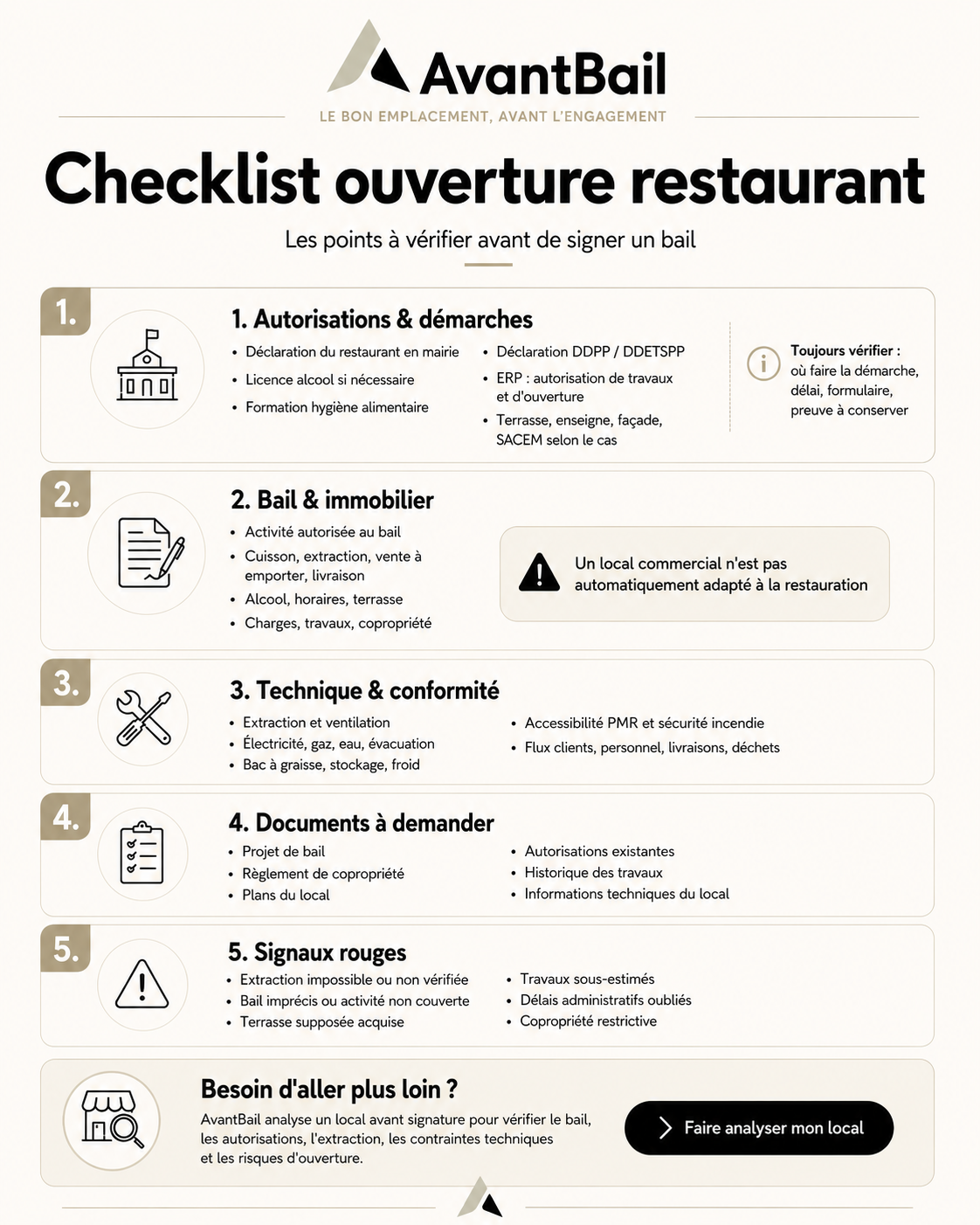
This AvantBail checklist helps identify the points to verify before signing, investing or starting works.
It covers opening a restaurant anywhere in France. The procedures often have a national basis, but the exact authority can vary depending on the commune (municipality), the département, the nature of the premises, the works, the activity, the public thoroughfare concerned or local rules. So the goal is not only to know that an obligation exists: you also need to know where to verify it, how to complete the procedure, what lead time to plan for and what proof to keep on file.
The essentials
The essentials to remember
Before opening a restaurant, you must check four families of risk.
Administrative permits
Company registration, declaration to the mairie (town hall), alcohol licence if required, ERP, terrace, storefront sign, food hygiene, DDPP, SACEM, works and the possible post-works opening authorisation.
Compatibility with the bail
The activity carried out in commercial premises must match the one set out in the bail (commercial lease). To add a complementary activity, the tenant must inform the landlord; to change activity, the landlord's agreement is required.
Technical feasibility of the premises
Extraction, ventilation, gas, electricity, water, drainage, grease trap, storage, refrigeration, waste, delivery, accessibility and fire safety.
Economic risk
Premises may be legally possible yet economically dangerous if the works, lead times, charges, copropriété (co-ownership) constraints or operating limits destroy the project's profitability.
Who is this checklist for?
This checklist is aimed at:
- independent restaurant operators;
- project owners;
- investors;
- franchisees;
- French and international franchise networks;
- real-estate agents specialising in commercial premises;
- owners or operators taking over a fonds de commerce (going-concern business);
- entrepreneurs who want to turn premises into a restaurant.
It mainly concerns traditional restaurants, brasseries, bistros, sit-down restaurants, restaurants with on-site cooking, and hybrid concepts with table service.
Section 1 · Permits
The permits and procedures to check before opening a restaurant
Registering the company
Before operating a restaurant, the company must be registered. Registration declares the existence of the activity and provides the company's official identifiers.
- Where
- Via the Guichet des formalités des entreprises (the single business-formalities portal). After this declaration, the restaurant is recorded in the RNE (national business register) and, where applicable, the RCS (trade and companies register). The company then receives a Siren number, a Siret and a proof of registration.
- When
- Before the activity starts.
How
- choose the legal form;
- file the formality on the Guichet des formalités des entreprises;
- declare the activity carried out;
- obtain the Siren, Siret and proof of registration.
Proofs to keep on file
- proof of registration;
- Siren / Siret number;
- RNE / RCS extract if applicable;
- articles of association if a company;
- assigned APE/NAF code;
- consistency between the declared activity, the bail and the actual operation.
The AvantBail risk — registration proves the company's legal existence, but it does not prove that the premises suit the activity. A restaurant can be correctly registered yet operate premises incompatible with the bail, the ERP status, kitchen extraction or hygiene rules.
With AvantBail
The AvantBail pré-diagnostic (pre-diagnosis) checks the consistency between the declared activity, the bail and the characteristics of the premises, to flag a point of concern before you commit.
Check the consistency of your premises →Declaring the restaurant to the mairie
A restaurant must declare its activity and its identity to the mairie (town hall) of the place where it is located. This declaration must be made at least 15 days before opening.
- Where
- To the mairie of the commune where the premises are located, using the official form to declare a restaurant or a drinks outlet for on-site or takeaway consumption. The exact authority must be confirmed for each commune via the official services.
- When
- At least 15 days before opening.
How
- complete the official declaration form;
- state the operator's identity;
- state the identity and address of the restaurant;
- submit or send the file to the competent mairie;
- keep proof of submission.
Proofs to keep on file
- declaration form;
- acknowledgement of receipt or proof of submission;
- correspondence with the mairie;
- confirmation of the declaration date.
The AvantBail risk — this declaration is simple, but it must be built into the opening back-schedule. It does not replace the other procedures: alcohol licence, ERP, DDPP, terrace, storefront sign, works or SACEM.
With AvantBail
From the address, AvantBail helps identify the local procedures to plan for and the competent authority, so you can place this declaration at the right point in the back-schedule.
Identify the procedures for your address →Alcohol licence and permis d'exploitation
If the restaurant sells alcohol, it must obtain the right to sell alcohol. Service-Public states that this right goes through a professional licence, also called permis d'exploitation (operating permit), with a mandatory 2.5-day (20-hour) training course.
- Where
- The permis d'exploitation training is provided by an approved body. The declaration linked to the restaurant or drinks-outlet activity is made to the authority indicated for the commune concerned. The mairie is generally the reference contact for the local declaration, but the competent authority must be confirmed for each territory.
- When
- Before opening, transfer, relocation or effective operation of the licence.
How
- identify the type of alcohol sale: during meals only, outside meals, bar, takeaway, late-night sale;
- identify the required licence: petite licence restaurant, licence restaurant, licence III, licence IV, or takeaway licence depending on the case;
- complete the mandatory training if required;
- make the declaration to the competent authority;
- keep the acknowledgement of receipt or supporting document.
To check before signing
- does the concept sell alcohol?
- is alcohol sold during meals only?
- is there a bar activity?
- is there any takeaway?
- does the restaurant open between 10 pm and 8 am?
- is the required licence available?
- does the bail authorise alcohol sales?
- does the commune or the area impose specific restrictions?
Proofs to keep on file
- permis d'exploitation training certificate;
- declaration made;
- acknowledgement of receipt;
- copy of the existing licence in the event of a takeover;
- confirmation of the competent authority if in doubt;
- bail clause authorising the actual activity.
The AvantBail risk — a restaurant, bistro, brasserie or wine bar can lose a significant part of its business model if alcohol sales are not properly anticipated, if the licence is not compatible with the actual operation, or if the bail does not cover the activity.
With AvantBail
AvantBail checks whether the planned alcohol sales are compatible with the bail and the area, so you know where you stand before signing.
Check the compatibility of the premises →Mandatory food hygiene training
In a commercial food-service establishment, at least one person must have completed the mandatory food hygiene training. This training lasts at least 14 hours.
- Where
- The training is delivered by a body approved by the ministry responsible for Agriculture. The list of bodies registered in a region can be consulted via the DRAAF or DAAF (regional agriculture directorate) of the region concerned, or through official resources such as Chlorofil.
- When
- Before opening or before the establishment begins to handle and serve food.
How
- check whether someone in the establishment is already trained;
- check whether a sector qualification already includes this requirement;
- check whether professional experience allows an exemption;
- choose an approved body;
- complete the training;
- keep the certificate.
To check before opening
- is someone in the establishment trained?
- is the certificate available?
- was the body properly approved?
- have the staff handling food received suitable instructions?
- are the hygiene procedures ready?
- have the sector's good hygiene practice guides been consulted?
Proofs to keep on file
- food hygiene training certificate;
- qualifications if claiming an exemption;
- proof of experience if claiming an exemption;
- internal hygiene procedures;
- cleaning records;
- temperature records;
- instructions given to staff.
The AvantBail risk — opening without proof of training or without clear hygiene organisation can create a risk during a health inspection. It can also reveal that the premises, the flows or the operation are not ready.
With AvantBail Ingénierie
On the execution side, AvantBail Ingénierie designs kitchens whose flows, workstations and forward-flow layout make day-to-day compliance with hygiene rules easier.
Discuss your kitchen project →DDPP / DDETSPP declaration for products of animal origin
Any establishment that produces, handles, processes, distributes, sells or stores food of animal origin must declare each of the establishments it is responsible for. This declaration also covers products containing animal ingredients, such as products with eggs, milk, cream, cheese, meat or fish.
- Where
- To the DDPP or DDETSPP (departmental population-protection directorate) of the département where the activity is located. The procedure can be done online or via the official form depending on the case.
- When
- Before opening, and to be renewed in the event of a change of operator, address or nature of activity.
How
- identify the products handled;
- check whether the activity sells only to the final consumer;
- check whether the activity also sells to other professionals;
- complete the official declaration if it applies;
- submit the declaration to the competent DDPP/DDETSPP;
- apply for an agrément sanitaire (health approval) if the activity sells to professionals and falls within the relevant scope.
Caution — agrément sanitaire
if the establishment sells animal products, or products containing them, to other professionals, an agrément sanitaire (health approval) may be required.
To check before opening
- does the restaurant handle meat, fish, eggs, milk, cream, cheese or composite products?
- does it sell only to end customers?
- does it also sell to professionals?
- does it do production, delivery, catering, a laboratory or a central kitchen?
- is the plan de maîtrise sanitaire (food safety management plan) ready?
- are temperatures monitored?
- is traceability organised?
Proofs to keep on file
- DDPP/DDETSPP declaration;
- acknowledgement of receipt or proof of submission;
- agrément sanitaire application if concerned;
- plan de maîtrise sanitaire (food safety management plan);
- temperature records;
- cleaning records;
- receiving records;
- pest-control / deratisation contracts;
- traceability procedures.
The AvantBail risk — premises may suit a retail sale-to-the-public activity yet be insufficient for a production, delivery, catering or professional-sale activity.
With AvantBail Ingénierie
Production, delivery or a laboratory: AvantBail Ingénierie sizes the kitchen, refrigeration and storage to the activity actually targeted, not the other way around.
Request a kitchen study →ERP, fire safety and accessibility
A restaurant that receives the public is generally an ERP (établissement recevant du public — public-access building). Creating, fitting out or modifying an ERP must be authorised by the mairie. The authorisation is granted subject to compliance with accessibility, fire safety and urban-planning rules.
- Where
- To the mairie of the commune where the premises are located. Depending on the project, this may be a déclaration préalable (prior declaration), a permis de construire (building permit) and/or an application to build, fit out or modify an ERP.
- When
- Before carrying out the works concerned and before opening to the public if an opening authorisation is required.
How
- identify whether the premises are an ERP;
- identify the ERP category and type;
- define the planned works;
- check whether the works alter accessibility, safety, the storefront, the structure or the destination (authorised use);
- prepare the plans;
- prepare the accessibility notice;
- prepare the fire safety notice;
- submit the file to the mairie;
- wait for authorisation before starting the works concerned.
Form to know
the application to build, fit out or modify an ERP is made in particular with Cerfa 13824*04 when the project is not subject to a permis de construire or a permis d'aménager (development permit).
To check before signing
- do the premises receive the public?
- is the capacity consistent with the exits?
- is PMR (reduced-mobility) accessibility compliant?
- are the toilets suitable?
- is fire safety compliant?
- do the works require an ERP authorisation?
- must a safety/accessibility commission be consulted?
- does the opening schedule account for the administrative lead time?
Proofs to keep on file
- ERP file;
- plans;
- accessibility notice;
- fire safety notice;
- works authorisation;
- déclaration préalable or permit if applicable;
- commission opinion if applicable;
- safety register;
- post-works attestations if required.
The AvantBail risk — signing a bail without checking the ERP status can lead to unplanned works, a delayed opening or the impossibility of operating the premises as intended.
With AvantBail
The AvantBail pré-diagnostic flags the premises' likely ERP status and the accessibility and safety constraints, so you can anticipate their impact before you commit.
Assess the premises before signing →ERP opening authorisation after works or a long closure
When an ERP has undergone construction or renovation works, or if it has been closed for more than 10 months, the operator must apply for an authorisation before opening to the public. The application must be made more than one month before the planned opening date.
- Where
- To the mairie of the commune where the premises are located, according to the procedure applicable to the territory concerned.
- When
- More than one month before the planned opening date to the public, where the application is required.
How
- check whether the premises have been closed for more than 10 months;
- check whether construction or renovation works have been carried out;
- apply for the opening authorisation;
- provide the requested attestations or documents;
- request, if necessary, a visit from the safety/accessibility commission;
- wait for the order or decision authorising the opening.
Proofs to keep on file
- opening authorisation application;
- submission letter;
- accessibility-compliance attestation if applicable;
- commission opinion;
- opening authorisation order (arrêté);
- official notification.
The AvantBail risk — signing a bail with an over-optimistic opening date can create a dangerous gap between the rent, the works, recruitment, financing and the actual authorisation to open.
With AvantBail
AvantBail helps compare your target opening date against the real administrative lead times, to avoid a costly gap between rent, works and authorisation.
Check the lead times with an adviser →Terrace and occupation of public space
If the restaurant wishes to install a terrace, a display or any element on public space, it must apply for a temporary authorisation to occupy public space, known as an AOT (autorisation d'occupation temporaire). Depending on the situation, this includes the permis de stationnement, the permission de voirie and the droit de place.
- Where
- The authority depends on the space concerned: the mairie for municipal public space, the EPCI (inter-municipal body), the département or another manager depending on the road. The voirie (highways) permission or authorisation form is used, in particular, to apply to temporarily occupy the public road domain or to run a temporary commercial activity on the public way.
- When
- Before installing the terrace, furniture, display, A-board, organised queue or any outdoor occupation.
How
- identify whether the space is public or private;
- check whether the terrace already exists;
- check whether the authorisation is attached to the operator or must be reapplied for;
- submit the application to the competent authority;
- comply with the areas, hours, furniture, pedestrian passage and fees;
- renew the authorisation if it is temporary.
To check before signing
- is the terrace essential to turnover?
- does the authorisation already exist?
- is it transferable or must it be reapplied for?
- what area is authorised?
- what hours are authorised?
- what fees are provided for?
- do the bail and the copropriété authorise outdoor operation?
- does the terrace create a nuisance risk?
Proofs to keep on file
- temporary occupation authorisation (AOT);
- permis de stationnement or permission de voirie;
- terrace plan;
- decision of the mairie or competent authority;
- fee amount;
- operating conditions;
- landlord's or copropriété's agreement if required.
The AvantBail risk — never treat a terrace as a given. If the business model depends on the terrace, its authorisation must be verified before signing.
With AvantBail
If your model relies on the terrace, AvantBail helps check whether it is realistic at this address: the sunlight during service hours, the orientation and the space that is actually usable — before you sign.
Check the terrace feasibility of this address →Storefront sign, façade and shopfront
Works that alter a commercial shopfront — window, façade, sign — require an administrative authorisation in most cases.
- Where
- Depending on the case, from the mairie or the authority indicated for the commune. For a new installation, a replacement or a modification of a sign, pre-sign or advertising, the official prior-authorisation form is Cerfa 14798.
- When
- Before modifying the façade, installing a sign, replacing a sign, fitting an awning, altering the window or installing a lit device.
How
- check the local advertising regulations (règlement local de publicité);
- check whether the building is in a protected area;
- check the copropriété constraints;
- obtain the landlord's agreement;
- prepare the visual, the dimensions and the placement;
- submit the required application or declaration;
- wait for approval before installation.
To check before signing
- does the restaurant's visibility depend heavily on the sign?
- can the existing sign be replaced?
- can the façade be modified?
- are the premises in a protected area?
- does the copropriété rulebook limit signs?
- must the landlord give agreement?
- is a lit sign planned?
Proofs to keep on file
- sign authorisation;
- façade or shopfront authorisation;
- landlord's agreement;
- copropriété agreement;
- approved plans, visuals and dimensions;
- applicable local rules;
- proof of submission.
The AvantBail risk — commercial visibility can be sharply reduced if the planned sign, façade or shopfront is not authorised.
With AvantBail
AvantBail spots the visibility constraints — protected area, sign rules, copropriété — that may weigh on the façade before you commit.
Check the visibility of the location →Music, SACEM and noise nuisances
If the restaurant plays music via radio, television, a streaming platform or any other medium, it must apply to SACEM (the French music copyright collection society) for prior public-broadcast authorisation, make a prior declaration and enter into a general representation contract.
- Where
- To SACEM, generally via the account or online service provided for music-broadcast authorisation requests.
- When
- Before any public playing of music.
How
- identify the type of broadcast: background music, television, playlist, DJ, event, terrace;
- declare the activity to SACEM;
- enter into the general representation contract;
- pay the applicable royalties;
- check the noise and neighbourhood constraints.
To check before signing
- does the concept plan for music?
- is music essential to the atmosphere?
- will there be a DJ, party or entertainment?
- will the terrace have sound?
- are the neighbours sensitive?
- do the bail or the copropriété limit nuisances?
- is an acoustic study required?
Proofs to keep on file
- SACEM declaration;
- general representation contract;
- proof of payment;
- acoustic study if carried out;
- clauses of the bail and the copropriété rulebook.
The AvantBail risk — a quiet restaurant, a musical bistro, an atmosphere bar and a festive restaurant do not carry the same level of risk. Music can entail costs, constraints and neighbourhood conflicts.
With AvantBail
Music bar, sound-equipped terrace or quiet restaurant: AvantBail helps anticipate the bail, copropriété and neighbourhood constraints tied to noise.
Discuss the constraints of the premises →Section 2 · Bail
The bail commercial: the first document to read before you picture the fit-out
The bail (commercial lease) must be read before you picture the fit-out. It can authorise, limit or prohibit certain uses.
The activity carried out must match the one stated in the bail. For a complementary activity, you must inform the landlord; to change activity, you must obtain the landlord's agreement. An unauthorised activity can expose the tenant to termination of the bail or a refusal to renew it.
Points to check in the bail
- exact destination (authorised use) of the premises
- authorised activity
- on-site dining
- takeaway
- delivery
- alcohol
- cooking
- extraction
- opening hours
- terrace
- storefront sign
- authorised works
- charges
- taxe foncière (property tax)
- major works
- ERP compliance
- accessibility
- compliance-works obligation
- assignment of the bail
- exclusivity clause
- copropriété rulebook
- nuisances
- non-compete clause in a shopping centre or gallery
Questions to ask before signing
- Does the bail explicitly authorise restaurant use?
- Does it authorise on-site cooking?
- Does it authorise extraction?
- Does it authorise takeaway?
- Does it authorise delivery?
- Does it authorise alcohol?
- Who pays for the compliance works?
- Does the landlord guarantee the intended use?
- Does the copropriété rulebook authorise this activity?
- Does the planned activity match the destination of the bail?
Red flag
a bail that authorises only « commerce alimentaire » (food retail), « salon de thé » (tearoom), « petite restauration » (light catering) or « vente à emporter » (takeaway) must not automatically be read as full authorisation for a restaurant with cooking, extraction, alcohol, terrace and delivery.
Section 3 · Extraction
Extraction, ventilation and nuisances: the critical point for restaurants
Extraction is often the real blocker.
A traditional restaurant can generate smoke, grease, steam, odours, heat and noise. Before signing, you must understand whether the premises technically allow the planned activity.
To check
- existing extraction
- diameter and condition of the duct
- roof outlet
- right to use the duct
- landlord's agreement
- copropriété's agreement
- possibility of creating a duct
- distance from windows, air intakes and neighbours
- filtration
- smoke extraction
- make-up air
- motor noise
- maintenance
- compliance of the installation
- compatibility with the cooking type: grill, deep-frying, wok, oven, plancha, rotisserie
Where to check?
- with the landlord
- with the syndic (managing agent) if copropriété
- in the copropriété rulebook
- in the old works files
- with an extraction / ventilation installer
- with a bureau d'études (engineering firm) if the project is sensitive
- with the mairie if the works affect the façade, the roof or urban planning
Documents to request
- plans of the premises
- ventilation plans
- maintenance reports
- photos of the duct
- past authorisations
- landlord's agreement
- copropriété's agreement
- technical specification of the extraction
- report from an installer or bureau d'études if available
Red flag
premises without extraction, or with unverified extraction, may be incompatible with the concept or require a budget far higher than the initial estimate.
Section 4 · Works
Works and CAPEX: what can blow up the budget
A restaurant often requires heavy works, even in premises that are already commercial.
Items to check
- extraction
- electricity
- gas
- plumbing
- drainage
- grease trap
- ventilation
- air conditioning
- heating
- fire safety
- accessibility
- toilets
- kitchen
- dishwashing area
- storeroom
- cold room
- washable surfaces
- façade
- storefront sign
- furniture
- terrace
- soundproofing
- compliance works
Possible procedures depending on the works
Depending on the nature of the project, the works may require:
- the landlord's written agreement;
- copropriété agreement;
- déclaration préalable de travaux (prior works declaration);
- permis de construire (building permit);
- authorisation to build, fit out or modify an ERP;
- accessibility file;
- fire safety file;
- façade or sign authorisation;
- post-works opening authorisation.
Key point
Creating, fitting out or modifying an ERP may require both an urban-planning authorisation and an authorisation tied to accessibility and fire safety.
Questions to ask before approving the budget
- Does the works budget include the regulatory constraints?
- Are the mairie/ERP lead times factored in?
- Is the electrical capacity sufficient?
- Does the landlord contribute to the works?
- Are the works authorised by the bail?
- Do the works require an architect, a bureau de contrôle (inspection body) or a prior authorisation?
- Can the premises open before all the works are finished?
- Does the rent run during the works?
Red flag
premises can be commercially attractive yet require a CAPEX out of proportion to the expected turnover.
Section 5 · Recap
Quick recap — the essentials at a glance
| Point to check | Where / with whom? | Proof to keep | Why it matters |
|---|---|---|---|
| Company registration | Guichet des formalités des entreprises | Siret, proof of registration | Prove legal existence |
| Restaurant declaration | Competent mairie | Declaration, acknowledgement of receipt | Mandatory before opening |
| Alcohol licence | Training body + competent authority | Permit, declaration, acknowledgement of receipt | Required if selling alcohol |
| Food hygiene training | Approved body, DRAAF/DAAF list | Certificate | Mandatory in commercial food service |
| DDPP / DDETSPP | Département of the premises | Declaration or approval | Mandatory depending on products and activity |
| ERP works | Mairie | ERP authorisation, safety/accessibility file | Blocks works or opening if overlooked |
| ERP opening authorisation | Mairie | Order (arrêté) or authorisation | May be required after works or a long closure |
| Terrace / AOT | Mairie, EPCI, département or highway manager | AOT, permit, plan | A terrace is never automatic |
| Sign / façade | Mairie or competent authority | Authorisation, approved visual | Direct impact on visibility |
| SACEM | SACEM | Contract, declaration, receipt | Required if music is played |
| Point to check | Risk if overlooked |
|---|---|
| Destination of the bail | Unauthorised activity |
| On-site cooking | Concept blocked or limited |
| Extraction | Works impossible or costly |
| Takeaway | Activity not covered |
| Delivery | Nuisances, flows, bail or copropriété |
| Alcohol | Licence and bail to check |
| Terrace | Turnover overestimated |
| Works | Cost and lead times underestimated |
| Copropriété | Blocks extraction, façade or nuisances |
| Charges | Reduced profitability |
| Point to check | Risk if overlooked |
|---|---|
| Electrical capacity | Equipment impossible to install |
| Gas | Works or safety constraints |
| Water and drainage | Non-compliant kitchen/dishwashing area |
| Grease trap | Problematic wastewater discharge |
| Cold storage | Limited hygiene and production |
| Waste | Nuisance and non-compliance |
| Supplier delivery | Complicated operation |
| Customer/staff flows | Poor ergonomics |
| Accessibility | ERP blocker |
| Fire safety | Works or refusal to open |
Section 6 · Documents
Documents to request before signing
Before signing a bail or a preliminary agreement, request at least:
- draft bail commercial
- destination of the premises
- copropriété rulebook
- existing authorisations
- plans of the premises
- technical plans
- diagnostics
- actual floor area
- detailed charges
- taxe foncière (property tax)
- works history
- previous ERP authorisations
- latest safety-commission opinion if available
- proof or description of the extraction
- existing terrace authorisation if applicable
- sign authorisation or local rules
- available electrical capacity
- gas supply if required
- wastewater drainage
- possibility of installing a grease trap
- technical photos
- the landlord's written agreement on the planned works
Section 7 · Pitfalls
Common mistakes before opening
1. Signing before checking the extraction
Extraction can decide the real feasibility of the concept. Without suitable extraction, some cooking methods become impossible or very costly.
2. Confusing « commercial premises » with « premises suited to a restaurant »
Commercial premises are not automatically suited to a restaurant. You must check the bail, urban planning, the ERP status, ventilation, plumbing, electricity and nuisances.
3. Treating the terrace as a given
A terrace depends on a local authorisation. It can be refused, reduced, seasonal, chargeable or subject to conditions.
4. Underestimating administrative lead times
The authorisations tied to works, the ERP, the façade, the terrace or the opening can change the actual schedule.
5. Not checking the copropriété rulebook
Even if the landlord is supportive, the copropriété can limit extraction, the façade, nuisances, opening hours or certain works.
6. Overlooking consistency between concept, bail and permits
A restaurant concept can combine several activities: on-site cooking, alcohol, terrace, delivery, music, events, takeaway. Each component must be checked.
Section 8 · Timing
When should you have the premises analysed?
It is recommended to have the premises analysed:
- before signing a bail;
- before paying a large security deposit;
- before commissioning the plans;
- before approving a works budget;
- before signing a franchise contract;
- before taking over a fonds de commerce;
- before announcing an opening date;
- before negotiating with a bank or an investor.
The right time is not after the works. The right time is before you commit.
Receive the full checklist by e-mail
This page covers the essentials. The full checklist — with the tick boxes, the lead times, the questions to ask and the red flags — is sent to you directly by e-mail, ready to take out on site or into a meeting. If your project already has an address, AvantBail can go further.
The full checklist includes:
- detailed table of permits
- the competent authority for each procedure
- the method to obtain each authorisation
- lead times to plan for
- proofs to keep on file
- mairie, ERP, DDPP, landlord and copropriété points
- documents to request
- red flags
- tick boxes
- risk level
- questions to ask before signing
The right location, before you commit.
Already have an address?
AvantBail analyses premises before signing to check whether the address, the bail, the permits, the extraction, the technical constraints, the ERP risks, the terrace, the works and the commercial potential truly match the intended concept.
Important note
This checklist does not replace a lawyer, an architect, a bureau de contrôle (inspection body), an accountant, a bureau d'études (engineering firm), a training body or the competent administration. It serves to identify the points of concern before signing, investing or starting works. The exact obligations can vary depending on the commune, the premises, the bail, the copropriété, the works, the activity and the mode of operation.