Market & Opportunities
Restaurants: why so many are closing in 2026 — and what we can learn before opening
07/01/2026 · 7 min
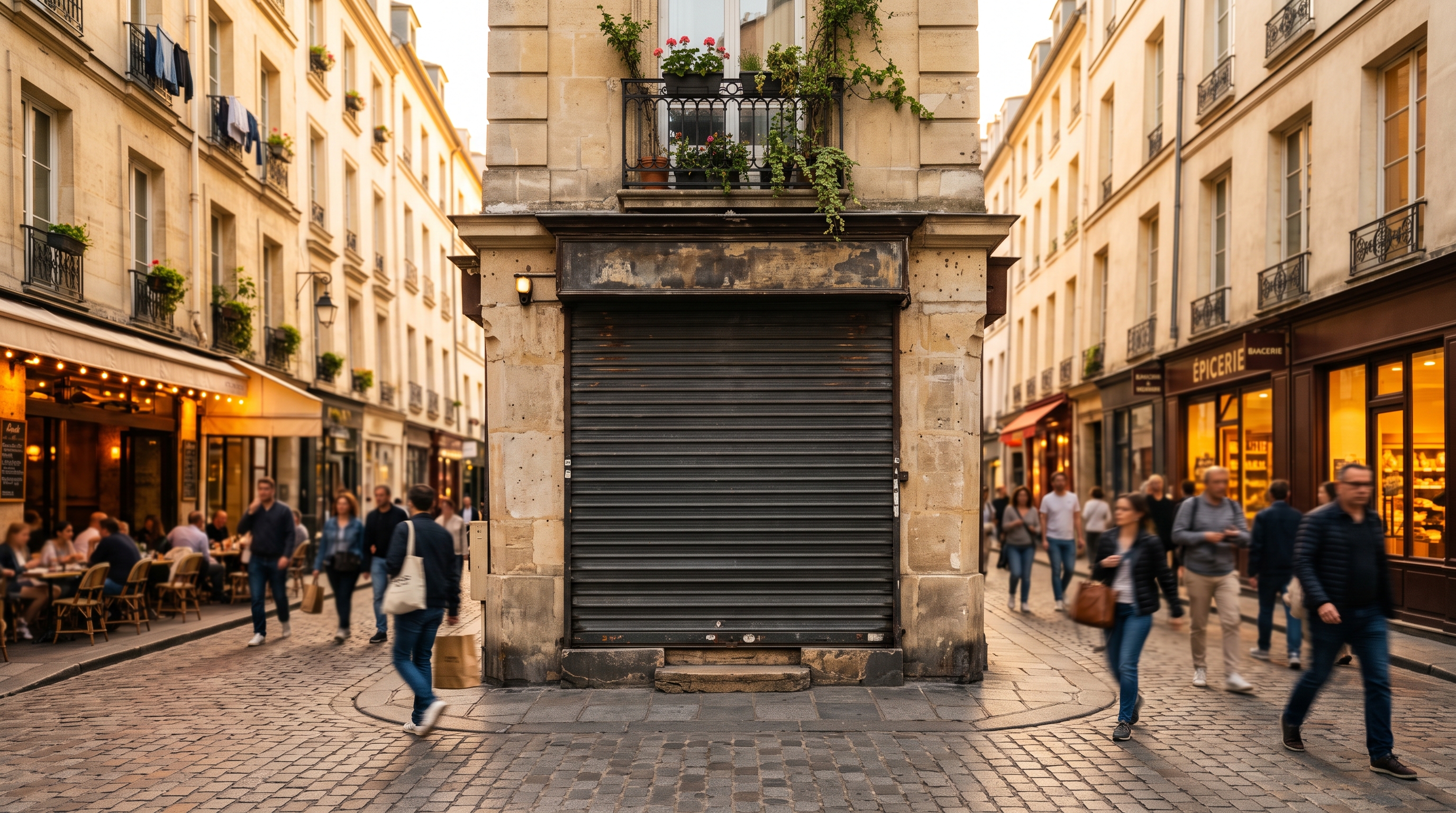
Nearly 9,400 business failures in the accommodation and food-service sector in 2026, a level 39% above the historical average. This isn't inevitable: every cause of closure is a variable that could have been checked before signing.
In France, opening a restaurant remains one of the most common projects among new business founders. And yet, never have so many establishments closed their doors as in recent years. In the first quarter of 2026 alone, the accommodation and food-service sector still recorded 2,101 insolvency (défaillance) proceedings in food service — a level that remains 39% above the historical 2010-2019 average, according to Altares. And since the start of 2022, the number of failures in the sector has quite simply doubled.
These figures have been circulating in the trade press for several months, often accompanied by the same somewhat fatalistic observation: the sector is suffering. Which is true. But what is rarely said is that behind every closure there are almost always one or more causes that could have been identified well before opening.
That's the real lesson of these statistics: not a reason to give up, but a list of variables to check before signing anything.
What the figures don't tell you
A business failure is a precise legal event — a redressement judiciaire (court-supervised recovery) or liquidation judiciaire (compulsory liquidation) proceeding, the data for which is published monthly by the Banque de France. What these statistics don't capture is all the closures that happened before reaching that point: the restaurateur who handed back the keys by mutual agreement, the one who sold at a loss, the one who held on for two years and then decided not to renew their bail commercial (commercial lease).
The real number of restaurants that close for good is therefore far higher than the official court proceedings alone.
What we also know is that closures are not distributed at random. They are concentrated among specific profiles: establishments launched without a serious catchment-area study, those whose premises were poorly suited to the concept from the outset, those that underestimated their fixed costs, and those that never managed to stabilise their team.
In other words: bad luck is rarely the first explanation. The causes are more systematic — and therefore more foreseeable.
Cause no. 1: costs that have exploded, in margins that have no margin
Food service is structurally a low-margin sector. In traditional restaurants, the net margin often runs between 3 and 5% of revenue under the best conditions, according to analyses by the firm In Extenso and the platform Extencia. This means that even a moderate rise in costs can be enough to tip into the red.
Yet since 2022, restaurateurs have absorbed simultaneous increases across almost all of their cost items: electricity, gas, food raw materials, packaging, maintenance. These increases did not ease off in 2026. They have partly stabilised — at high levels.
What could have been anticipated: the energy cost of a commercial premises depends very directly on its technical characteristics — the age of the electrical installation, available power, insulation, type of heating. A poorly insulated or electrically under-supplied premises will generate disproportionate energy costs from the very first winter. This isn't visible during a quick viewing — it's visible when you look at the previous tenant's meter readings, or when you have the installation inspected before signing.
The variable to check: before committing to a premises, ask for the energy bills from the last 12 months. If the owner can't provide them, that's a signal.
Cause no. 2: premises that didn't match the concept
This is probably the most underestimated cause in the post-mortems of closed restaurants. There's little talk of the mismatch between the premises and the project — because it's a mistake made upstream, before opening even happens, and it's hard to admit once you've signed the bail commercial.
A premises can be attractive, well located, correctly sized — and yet incompatible with the intended concept. The reasons are many:
- The kitchen is too small for the volume of covers envisaged
- It's impossible to install an extraction (extraction/ventilation) duct up to the roof (building under copropriété — joint ownership, local regulations)
- Deliveries are physically difficult (pedestrian street, no drop-off zone)
- The planned terrasse (outdoor seating) cannot be authorised as things stand
- The layout doesn't allow people with reduced mobility to be accommodated without heavy works
Each of these points is verifiable before signing. None of them is easy to verify during a first viewing, without an analysis framework.
What could have been anticipated: a preliminary diagnostic of the premises — technical, regulatory and commercial — makes it possible to map these incompatibilities before any commitment. It's not an absolute guarantee (some points require an on-site visit with a professional), but it's a way of eliminating the most obvious non-conformities before you even begin to negotiate.
Cause no. 3: an overestimated customer catchment area
The second classic blind spot is the catchment area (zone de chalandise). How many people actually walk past this premises each day? At what time? Are they working people looking for a quick lunch, local residents, passing tourists?
These questions seem simple. They aren't. There's a tendency to overestimate footfall on the strength of a viewing on a sunny Thursday lunchtime — and to discover that on a Monday morning or a Saturday evening, the street is almost deserted.
The reality is that footfall varies according to:
- The time of day
- The day of the week
- The season
- Construction works or developments within a short radius
- The presence or absence of footfall generators (offices, schools, markets, public transport)
The 2026 food-service Observatory from Panthéon Conseil also points out that the mid-range segment (average spend between €45 and €80) is the most fragile at present — precisely because its target clientele has visiting habits that are highly concentrated both geographically and by time of day.
What could have been anticipated: visit the premises at several different times, weekday and weekend, morning and evening. Observe what the neighbouring businesses do — their occupancy rate, their longevity, their type of clientele. Compare the density of restaurants already present within a short radius.
Cause no. 4: recruitment, the unforeseen factor that kills projects over time
42% of restaurateurs report facing recruitment difficulties, according to data published by France Travail and DARES. And the most striking figure: staff turnover in the hospitality and food-service sector is around 44 to 50% — compared with roughly 15% on average in other sectors (INSEE/DARES). In practical terms, only two-thirds of the sector's employees keep their job for more than a year.
These are figures that many project leaders are vaguely aware of, but don't really factor into their business plan. Yet the consequence is direct: an understaffed restaurant closes off covers, reduces its opening hours, degrades service quality, loses regular customers. The vicious circle sets in fast.
What could have been anticipated: recruitment in food service doesn't begin the month before opening. The best practices of restaurateurs who stabilise their teams are well known: full transparency on conditions and hours right from the job posting, displayed pay, a clear plan for the establishment, real prospects for advancement.
Well-thought-out premises help too: an organised kitchen space, a decent working atmosphere, proper changing rooms. Teams stay more readily in establishments where they don't suffer physically.
What these causes have in common
If we look at these four causes together — energy, unsuitable premises, catchment area, recruitment — we notice something: none is a surprise once you know where to look.
All are variables that can be assessed, at least partly, before opening. Some require a professional on site. Others can be analysed with public data and a bit of method. Many can simply be anticipated by asking the right questions at the right time — before signing the bail commercial, not after.
The difficulty is that the enthusiasm of the project often pushes people to play down these warning signs. You want the premises to work. You've already pictured the full dining room, the polished concept, the positive reviews. And so you skim over the points that should be rational decisions.
Another way to read these statistics
The level of business failures in food service remains abnormally high compared with the sector's history — 39% above the average of the 2010-2019 years. But the first data for 2026 hints at a slight stabilisation, after two particularly difficult years. It's not a return to normal, but it's a signal that establishments that prepared their launch well are holding up better than the rest.
Thousands of restaurants open every year and last. Some thrive. What these figures show is that the projects that fail often have one thing in common: they under-invested in the diagnostic phase — the period between "I have an idea" and "I sign my lease and order my equipment".
This phase is uncomfortable because it slows things down. It forces you to ask questions you may not necessarily want to hear the answers to. But it's also the only period when correcting course is still possible without losing money, time or energy.
How AvantBail can help
AvantBail was designed for this pre-commitment phase. Starting from an address, the pre-diagnostic automatically analyses what can be assessed remotely — the premises' activity history, the regulatory zone, the density of competition nearby — and identifies the points that require an on-site check or a professional's opinion.
The result is not a guarantee of success. It's an honest map of what we know, what we consider probable, and what can't be settled without going further. A documented starting point, so that the decisions that follow are based on something other than intuition alone.
If you have an address in mind, now is the time to run it through a pre-diagnostic.
Sources
- Altares — Business failures Q1 2026 — accommodation and food-service sector data, historical 2010-2019 comparison
- Banque de France — Business failures 2026 — official monthly statistics
- In Extenso — Financial difficulties of restaurants — analysis of margins and costs
- Extencia — Key food-service figures 2026 — profitability and sector indicators
- Panthéon Conseil — Food-service Observatory 2026 — market and segment analysis
- DARES / France Travail — Food-service recruitment — turnover rate, recruitment difficulties
- L'Hôtellerie Restauration — Food service under strain — trade press analysis
The data cited in this article comes from public sources and sector observatories. It provides market benchmarks, not certainties applicable to every situation. Any restaurant-opening project should be supported by professional advice tailored to its specific circumstances.
How AvantBail can help
A location in mind? Document it before you commit.
Start with the free pre-diagnostic to place the address in a few minutes. To go further — every point checked, sources included, before you sign — the full AvantBail report documents every step.