Checklists
Opening a restaurant: the complete checklist of 50 procedures (2026)
06/25/2026 · 7 min
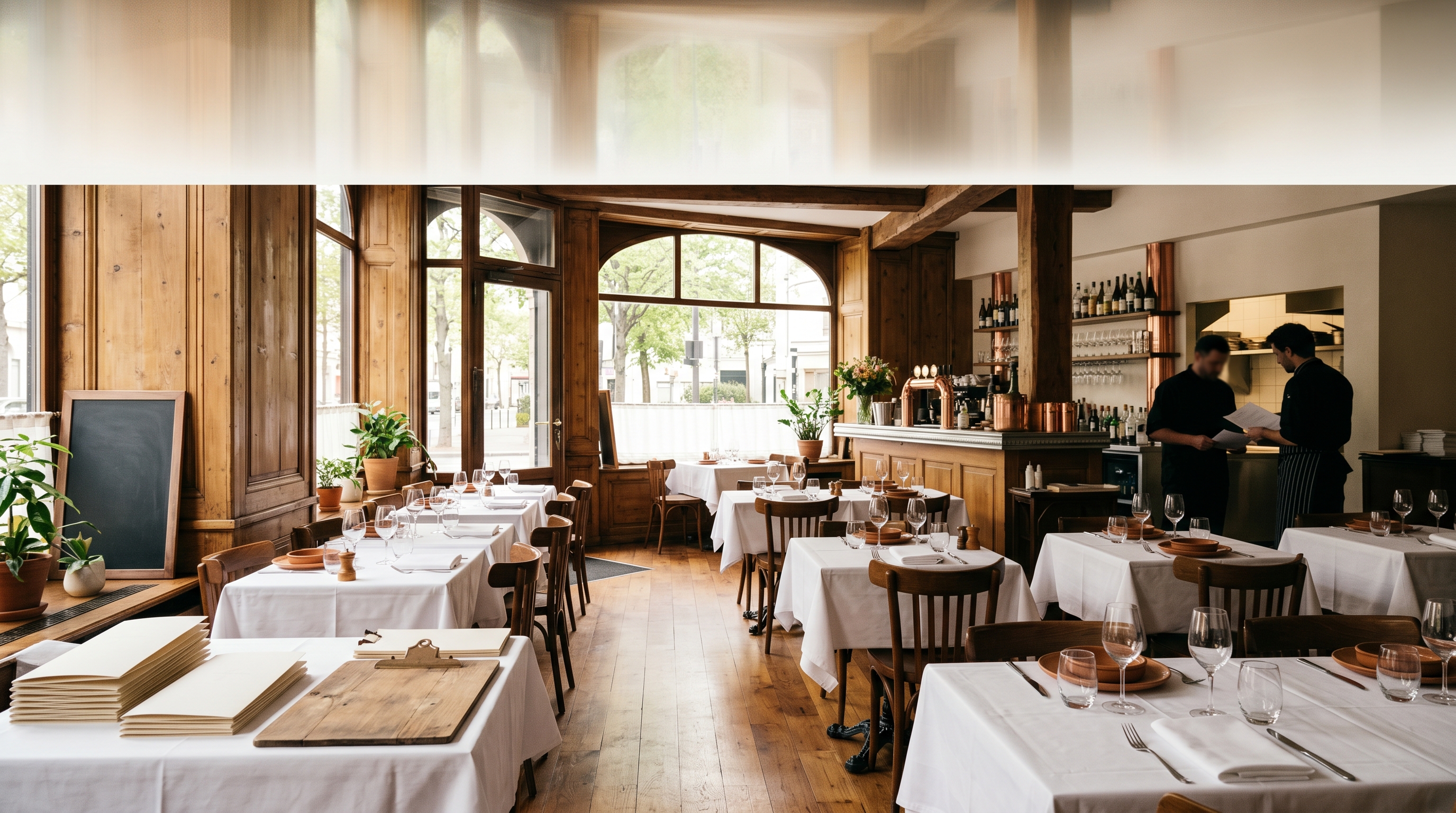
The reference checklist, from choosing the premises to opening day. Grouped into blocks: premises & lease (bail commercial), urbanism (destination/usage), ERP & safety, PMR accessibility, hygiene (DDPP), licence & alcohol, works & extraction, insurance, hiring. Each step = who to contact + indicative timeframe. CTA: pre-diagnostic of the premises.
Opening a restaurant: the complete checklist of 50 procedures (2026)
You have spotted a premises and you are wondering whether it can really become a restaurant? Before signing the lease, it is better to work through all the procedures for opening a restaurant: some are settled in a few days, others determine the entire feasibility of the project. This checklist serves as a pré-diagnostic (preliminary feasibility assessment): it helps you anticipate, know who to contact and within which indicative timeframes. Keep in mind three statuses that recur throughout the list: [Confirmed] (verifiable on file), [Probable] (very common but to be confirmed) and [To verify] (depends on the premises, to be validated on site). Timeframes often overlap: read the list as a map, not as a straight line.
1. Premises & lease (bail commercial)
Everything begins with the premises and the contract that binds you to it.
- Check the nature of the lease (bail commercial 3/6/9, short-term derogatory lease, etc.). Who: landlord / real-estate agent. Timeframe: before signing.
- Read the destination/activity clause to find out whether restaurant use is authorised. Who: lawyer or chartered accountant (expert-comptable). Timeframe: 1-2 weeks. [To verify]
- Request the diagnostics and the inventory of fixtures (DPE energy diagnostic, asbestos, electricity, etc.). Who: landlord. Timeframe: before signing.
- Identify the charges, taxes and works that fall to you. Who: landlord. Timeframe: before signing.
- Check the actual usage of the premises (usage) (residential, commercial, office). Who: mairie (town hall) / notaire. Timeframe: 1-3 weeks. [To verify]
- Negotiate a condition precedent (condition suspensive) tied to the urbanism authorisations. Who: lawyer. Timeframe: at signing.
2. Urbanism: destination & usage
"Usage" and "destination" are two distinct notions: a premises can be commercial without being authorised for restaurant use.
- Consult the PLU (local urban plan) and the zoning of the municipality. Who: urbanism department of the mairie. Timeframe: a few days.
- Determine whether a changement de destination (change of destination) is required (towards "restaurant use"). Who: mairie. Timeframe: 1-2 weeks. [Probable]
- File a prior declaration (déclaration préalable) or a building permit (permis de construire) depending on the scale of the works. Who: mairie. Timeframe: processing 1 to 4 months.
- Check for any protected area (opinion of the Bâtiments de France). Who: mairie / UDAP. Timeframe: +1 month if concerned. [To verify]
- Study the rules on terraces and occupation of public space. Who: mairie. Timeframe: 1-2 months.
3. ERP & fire safety
A restaurant is an establishment open to the public (ERP), type N. The rules depend on the seating capacity. Useful public reference: the ERP fact sheet from Bpifrance Création.
- Identify the type (N) and the ERP category according to the number of people accommodated. Who: mairie / inspection office (bureau de contrôle). Timeframe: a few days.
- File the ERP works authorisation (autorisation de travaux). Since 28 May 2026, for certain premises under 300 m² keeping the same activity, it may be replaced by a declaration of conformity. Who: mairie. Timeframe: processing up to 4 months. [To verify]
- Have the file reviewed by the commission de sécurité (safety commission). Who: mairie / fire services. Timeframe: opinion within ~2 months. [Probable]
- Obtain the authorisation to open to the public (mayoral order / arrêté du maire). Who: mairie. Timeframe: before opening.
- Set up the safety register and the inspections (extinguishers, alarm, smoke extraction). Who: inspection office (bureau de contrôle). Timeframe: before opening.
- In case of a takeover, recover the minutes (PV) of the last commission. Who: mairie / outgoing operator. Timeframe: at takeover. [To verify]
4. PMR accessibility
Every ERP must be accessible to people with reduced mobility (PMR) (a principle laid down by the law of 11 February 2005). Public sources: Ministry for the Ecological Transition and service-public.gouv.fr.
- Carry out a self-assessment (entrance, circulation, sanitary facilities). Who: operator / architect. Timeframe: 1-2 weeks.
- Have the accessibility certificate (attestation d'accessibilité) drawn up (self-declared for category 5; by a professional for categories 1 to 4). Who: operator or architect. Timeframe: a few days.
- Submit the certificate to the préfecture and the municipality. Who: préfecture / mairie. Timeframe: before opening.
- File a request for an exemption (dérogation) if bringing the premises up to standard is technically impossible. Who: préfecture / accessibility commission. Timeframe: reply ~3 months. [Probable]
- Compile the public accessibility register (mandatory in every ERP). Who: operator. Timeframe: before opening.
- Train the team to welcome members of the public with disabilities. Who: training body / OPCO. Timeframe: 0.5 to 1 day.
5. Hygiene & DDPP
The DDPP (Direction départementale de la protection des populations, the departmental population-protection authority) is your hygiene contact. Public details: service-public.gouv.fr.
- Have at least one person in the establishment complete the food hygiene training (14 h). Who: training body. Timeframe: ~2 days.
- Draft the Sanitary Control Plan (Plan de maîtrise sanitaire, PMS) — your hygiene and traceability procedures. Who: operator. Timeframe: 2-4 weeks.
- Declare the establishment to the DDPP (handling of foodstuffs of animal origin). Who: DDPP / DDETSPP. Timeframe: before opening. [To verify]
- Check whether a sanitary approval (agrément sanitaire) is required (sale to other professionals). Who: DDPP. Timeframe: before opening.
- Organise the cold chain, the "forward flow" (marche en avant) and traceability. Who: operator. Timeframe: during fit-out.
- Put up the mandatory signage (allergens, smoking ban, protection of minors). Who: operator. Timeframe: before opening.
6. Licence & alcohol
Serving alcohol requires a licence and training. Public reference: service-public.gouv.fr.
- Choose the appropriate licence: petite licence restaurant (alcohol ≤ 18°) or licence restaurant (all alcohol), with service during meals. Who: operator. Timeframe: in advance.
- Complete the permis d'exploitation training (operating permit, 20 h, valid 10 years). Who: body approved by the Ministry of the Interior. Timeframe: ~3 days.
- Check the protected perimeters (périmètres protégés) (schools, hospitals, places of worship) before signing. Who: préfecture / mairie. Timeframe: 1-2 weeks. [To verify]
- Declare the licence at the mairie at least 15 days before opening. Who: mairie (préfecture de police in Paris). Timeframe: 15 days.
- To serve alcohol outside meals, plan for a licence III or IV (transfer or purchase). Who: préfecture. Timeframe: variable. [To verify]
- Complete the permit to sell alcoholic beverages at night (7 h) if you serve between 10 p.m. and 8 a.m., then display the licence in the dining room. Who: approved body. Timeframe: ~1 day. [Probable]
7. Works & extraction
Kitchen fume extraction is often the point that makes or breaks a restaurant project in existing premises.
- Have the works costed by a project manager (maître d'œuvre) or an architect. Who: architect. Timeframe: 2-4 weeks.
- Check the feasibility of the extraction (duct, roof outlet). Who: engineering firm (bureau d'études) / architect. Timeframe: 1-3 weeks. [To verify]
- Obtain the landlord's written agreement for the works and the extraction. Who: landlord. Timeframe: 2-4 weeks.
- Obtain the copropriété (co-ownership) agreement (duct, façade) at a general meeting. Who: managing agent (syndic) / general meeting. Timeframe: 1-3 months. [Probable]
- File the prior declaration (déclaration préalable) for the sign and the shopfront. Who: mairie. Timeframe: ~1 month.
- Size the ventilation/VMC, electricity and plumbing to standard. Who: engineering firms (bureaux d'études). Timeframe: during the works.
8. Insurance
Several types of cover must be put in place before opening.
- Take out professional civil liability insurance. Who: your insurer. Timeframe: before opening.
- Take out multi-risk professional insurance (premises, equipment, stock). Who: your insurer. Timeframe: before opening.
- Plan for business interruption cover. Who: your insurer. Timeframe: before opening.
- Adapt the cover to the drinks service and the terrace. Who: your insurer. Timeframe: before opening. [To verify]
9. Hiring & social start-up
The last block before service: the team and the employer obligations.
- Apply the HCR collective agreement (hotels-cafés-restaurants). Who: operator / chartered accountant (expert-comptable). Timeframe: in advance.
- Complete the DPAE (pre-employment declaration) for each employee. Who: URSSAF. Timeframe: before hiring.
- Organise the information and prevention visit. Who: occupational health service. Timeframe: within ~3 months.
- Keep the single staff register and the mandatory social signage. Who: operator. Timeframe: from hiring.
In summary: from the premises to opening day
These 50 procedures show one thing: a restaurant's feasibility is decided first and foremost by the premises. Authorised destination, ERP classification, accessibility, extraction and protected perimeters can turn a "lovely premises" into a blocked project — or, conversely, secure your choice very early on. The right reflex is to sort, right from the visit, what is confirmed, probable or to verify on site, and to prioritise the points that determine everything else.
This is exactly what the AvantBail feasibility pré-diagnostic makes possible: putting a premises through these criteria before signing, so you can move forward with full knowledge of the facts. Launch the pre-diagnostic of your premises — and if your project is under way, we can also support you in carrying out the procedures.
How AvantBail can help
A location in mind? Document it before you commit.
Start with the free pre-diagnostic to place the address in a few minutes. To go further — every point checked, sources included, before you sign — the full AvantBail report documents every step.